We were looking out of the bus window and wondering what to expect, our backpacks crushing our jittery legs. We arrived at Yangshuo and got off the bus. A dozen taxi drivers approached us to get us to the hostel, we politely declined and started walking towards the once sleepy town centre. As we were approaching West street more and more restaurant staff were calling us from inside their establishment “very clean”, “delicious food”, “we are on TripAdvisor”. Increasingly, the crowd grew, loud music, lights and bars (something we had thought did not exist in China as we had desperately but unsuccessfully searched for one in Guilin). We carried on towards the north of town, up a hill where our hostel was located, the crowds started changing, where they had been mainly tourists, the crowd was now full of locals browsing fresh produce, the countryside started to be more visible and we started to understand the appeal of this small town.
We had read many blogs suggesting to skip Guilin and increasingly, many more suggesting to skip Yangshuo but we are big believers on giving places a chance and, if you know how to oversee the negative cons, every place has its charm and Yangshuo did not disappoint! Whether you visit on a day trip or you stay, do not miss the countryside of this incredible region
Welcome to our guide of Yangshuo!
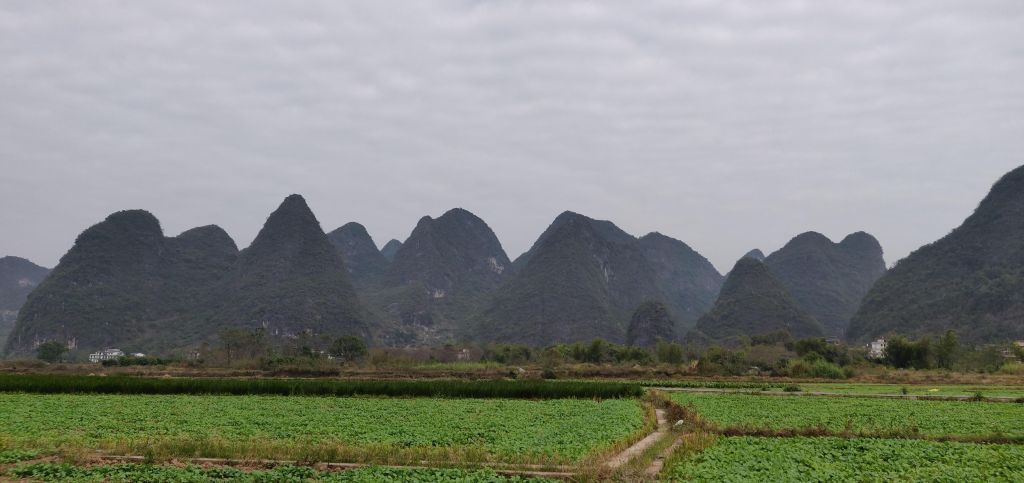
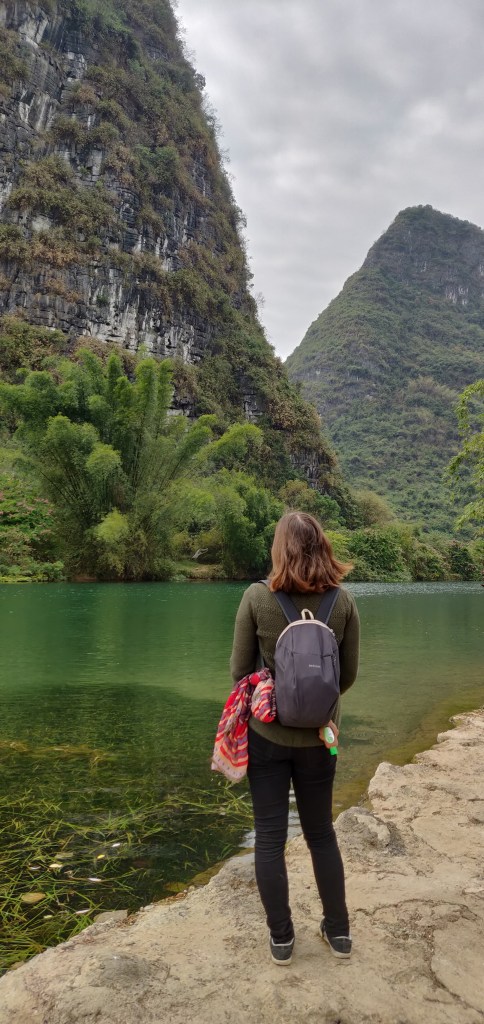
Stunning countryside in Yangshuo
Best time to visit
Similarly to Guilin, it’s best to visit sometime between April and October although we went in November and although a little cold, there were plenty of sunny days to enjoy.
How to get in and around Yangshuo?
You will normally arrive at Yangshuo either by bus from Guilin, Xinping or by boat with a tour from Guilin. The bus station in Yangshuo is located just outside of town and it is walking distance to West street (around 20min) but taxis are readily available (just make sure to barter before entering or make sure the meter is on). Within town, everything is walking distance, but if you want to visit the countryside it is recommendable to hire a bicycle or moped from either your accommodation or a renting company (beware of scams).
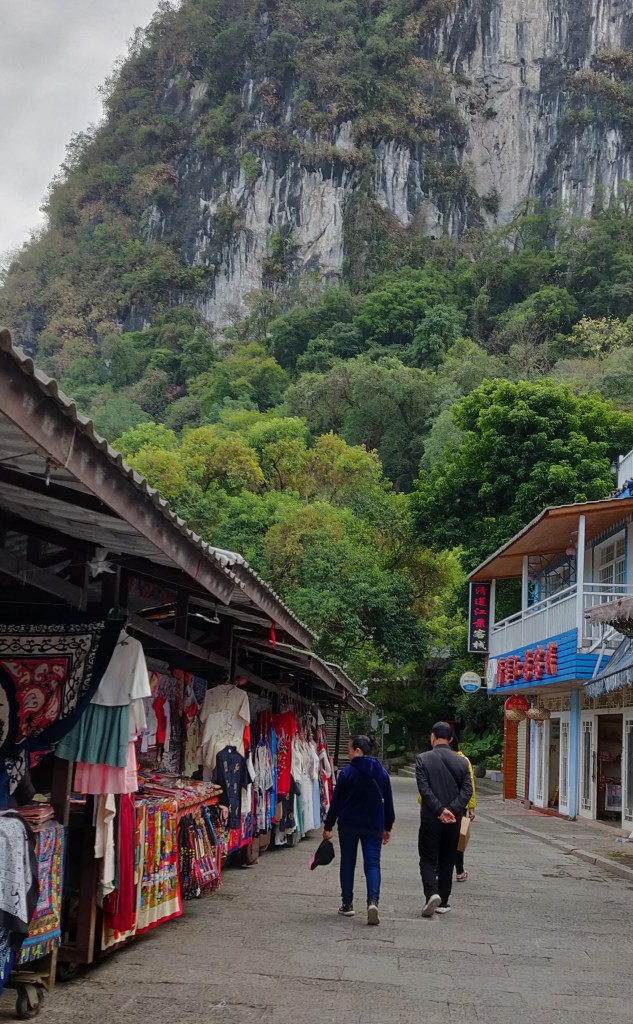
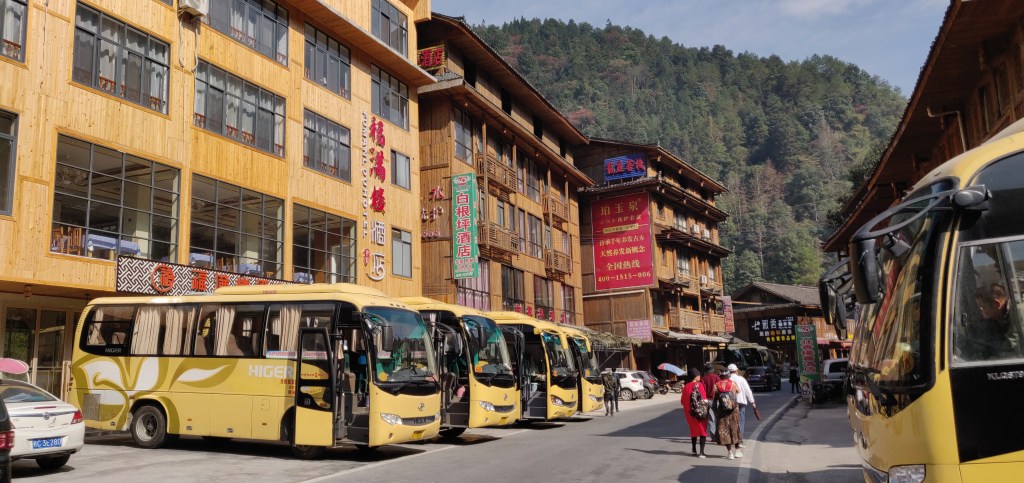
Some streets we walked past on our way from the bus stop
What to do in Yangshuo?
This countryside village has plenty to offer, there are boat tours, nightlife and excursions but these were our favourite activities in Yangshuo.
Impressions Liu Sanjie – Price around 200RMB (more for transport that can be purchased at your accommodation)
This incredible show of lights and music by the Li River is a must when you visit Yangshuo, the setting is actually the largest natural auditorium and it is in complete equilibrium with nature, using the natural islands within the river as part of the scenery. The 70 min show features 6 chapters in colours representing features from the region and Liu Sanjie, a legendary fairy singer. Liu was known by the Zhuang ethnic minority as a Goddess of singing, she was thought to be enslaved and oppressed due to jealousy for her gift. She is a very loved figure for Zhang and this show. For more information check out this website.
How to get to the Lui Sanjie theater? Head to East street and either walk to the theater (30 min) or take the complimentary shuttle car.
Cycling around the countryside: Yulong river and Dragon bridge – 10RMB each bike rental.
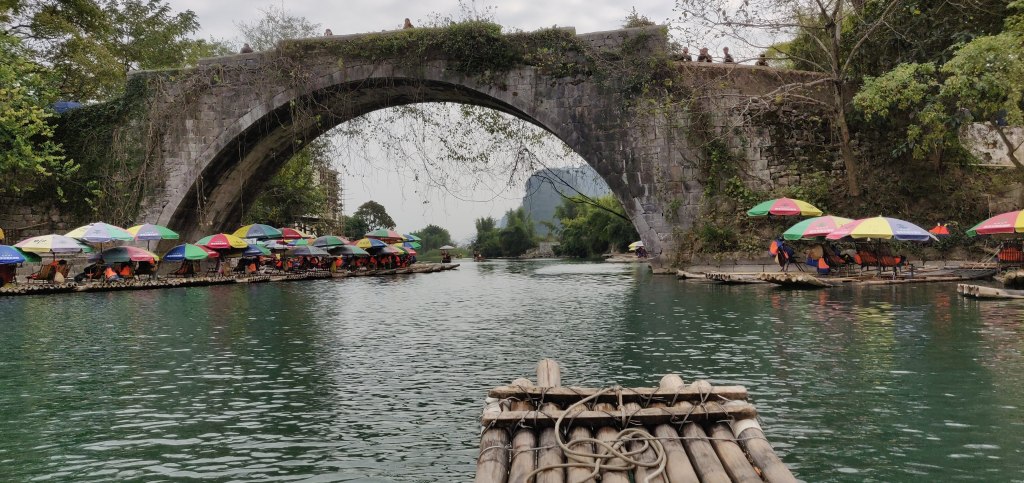
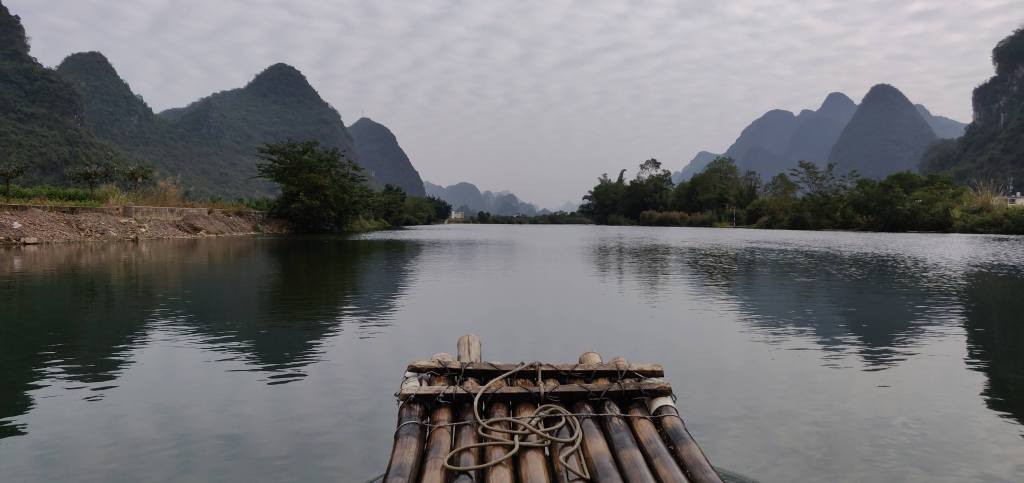
One of the highlights of our time here was definitely cycling along the Yulong river and the countryside surrounding Yangshuo. We hired our bikes from our hostel for 10RMB each. The landscape and atmosphere is beautiful and the terrain is very easy (not a lot of hills and paved paths), there are some bridges where you must pick up your bike as there are stairs). Once you reach the Dragon bridge there is a small market where you can refuel and buy traditional trinkets, also you can descend a part of the way back by bamboo raft from a station just north of the Dragon bridge (we paid 250RMB for a raft and 20RMB extra for them to drive the bikes down to the endpoint) IMPORTANT: Make sure you keep your valuables in waterproof bags as your feet and bums will get wet and you will get splashed.
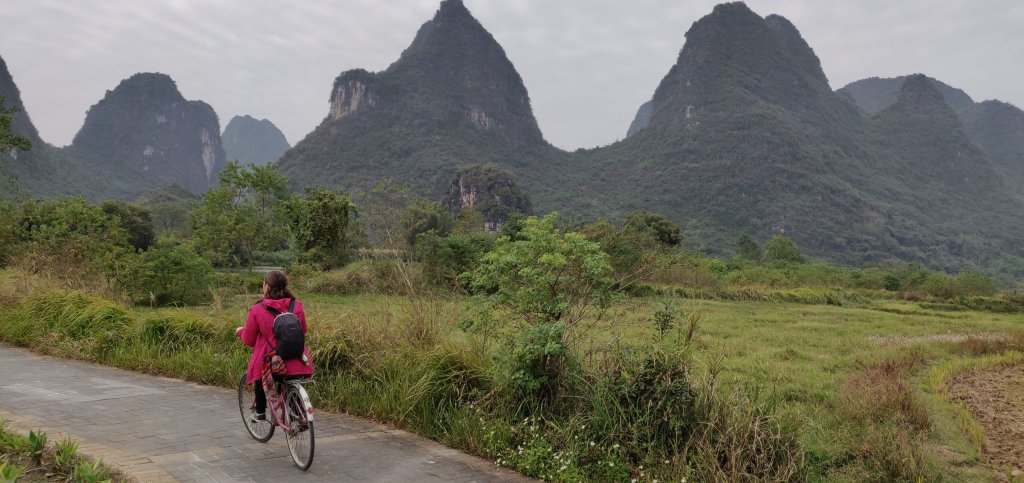
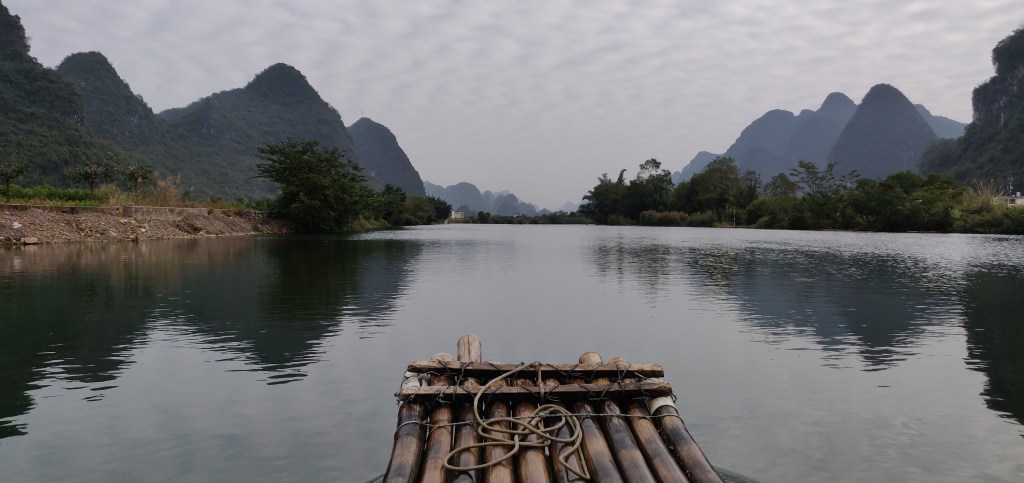
Cycling the countryside around YangshuoDragon Bridge from our bamboo raft ride
Eating in Yangshuo
The cuisine in Yangshuo does not vary much from the city of Guilin, however, there is a local speciality, Yangshuo beer fish (Pijiu Yu 啤酒鱼). Legend says that a local restaurateur was cooking the famous fresh Li River carps when his beer fell into the pan, instead of throwing the dish away he tried it, becoming one of the signature dishes of the town. Beer fish is cooked in camellia oil with fresh water from the Li River and beer. If you want to try this local delicacy you must go to MeiJie Yangshuo, we absolutely loved it!
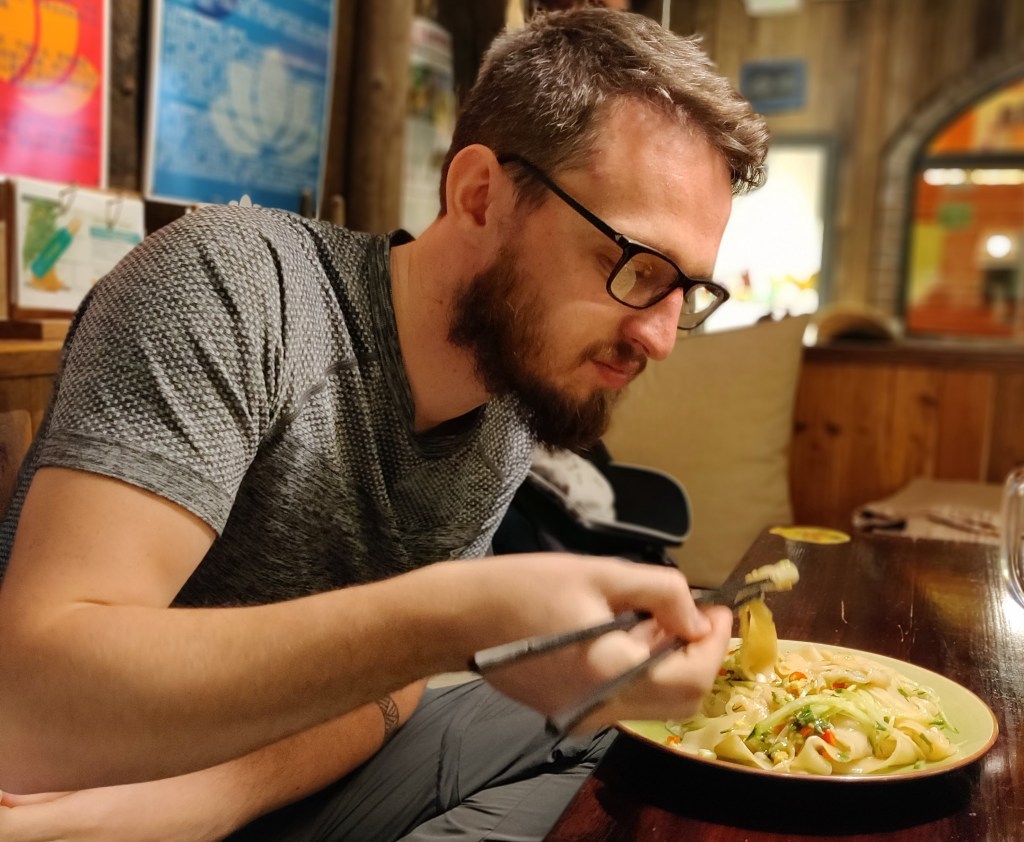
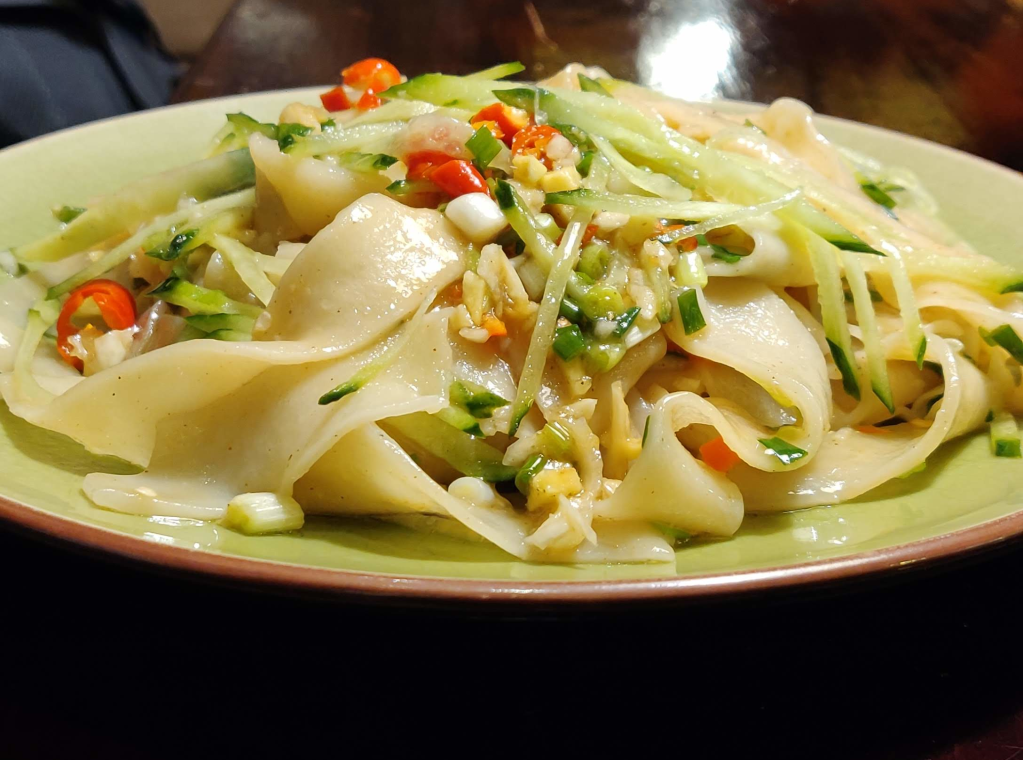
Aside from this restaurant, we found a highlight for vegetarians and vegans, it’s called Mood Food Energy Cafe. There, you can try the local delicacies but completely guilt and worry-free! We had the famous Guilin noodles and dumplings and they were to die for! Plus the local beer was delicious.
Pete enjoying vegan Guilin noodles at Mood Food Cafe
For more info on food in the region which is applicable to Yangshuo, please check out our guide to Guilin.
Where to stay
The price of your accommodation will heavily rely on where and where you are planning to stay, we decided to find accommodation quite far from the centre (30min walk from West street) but as a result we got a cheap but spacious and quality room. These are our recommendations:
Mid-range: ££-£££
Yangshuo Mountain Retreat: Although not so close to town, this hotel is just Instagram material of dreams. Designed with a rustic, traditional interior still keeps contemporary features. The staff is extremely attentive too. Staying here you can really experience the peace and serenity so characteristic of the region.
Zen Tea House: The interiors in this centric hotel are simple but gorgeous and, not surprisingly, zen. The location could not be better, just next to West street.
Cheap: £-££
Mountain Stream Inn Yangshuo: This was one of our favourite places we stayed in during our trips. It is also decorated quite “zen” with concrete and wood blending together. It has all the facilities of a youth hostel and even bike rental and it is cheap! The only downside is its location, a bit far from town by walk.
Yangshuo Sudder Street Guesthouse: Very close location to Mountain Stream (around 30 min from West street) but lively and also very tastefully decorated, the food is delicious and the views from the pool unmissable.
Wada Hostel: If you want a young and lively atmosphere, events and great location this is the right hostel for you. Located in West street it has a stunning rooftop from where to watch the sunset.
Overview
We went to Yangshuo without really knowing what to expect. It was once a sleepy village where a few scattered tourist off the beaten path used to go to escape the mass tourist of Guilin and experience a more authentic countryside experience. However, Yangshuo is no longer this sleepy village, it is now a tourist hub targeting mainly adventure tourism but also catering for visitors to the karst landscape. Where once there were traditional cormorant fishermen, today there are men with cormorants posing for photos (yes, this traditional technique has long been extinct).
Saying this, we absolutely loved our time here. In our experience we could find enough tranquility among al the nightlife and tourist areas as we were staying off the town centre (West street) and we mainly explored the countryside by ourselves. The natural beauty of the area is the best attribute and so it made it worth having to share it with other tourists (after all, aren’t we tourists too?)
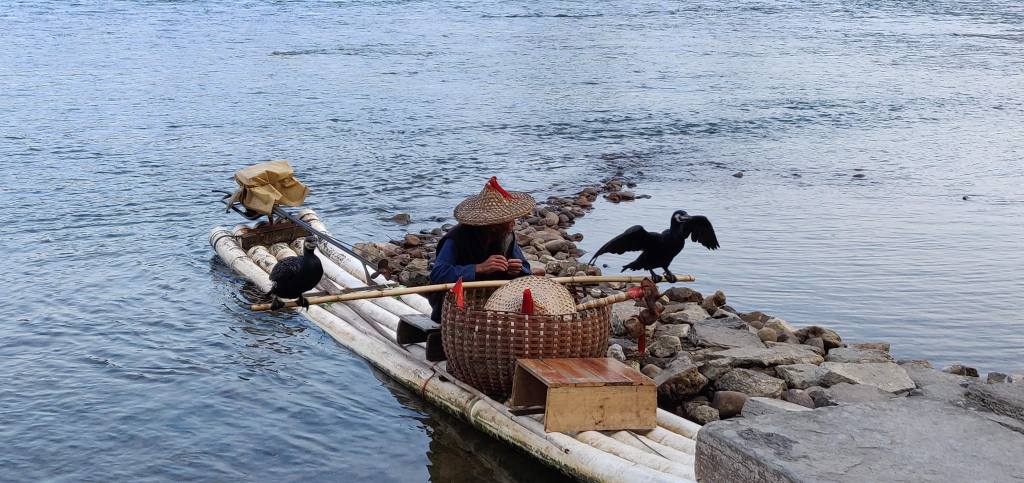
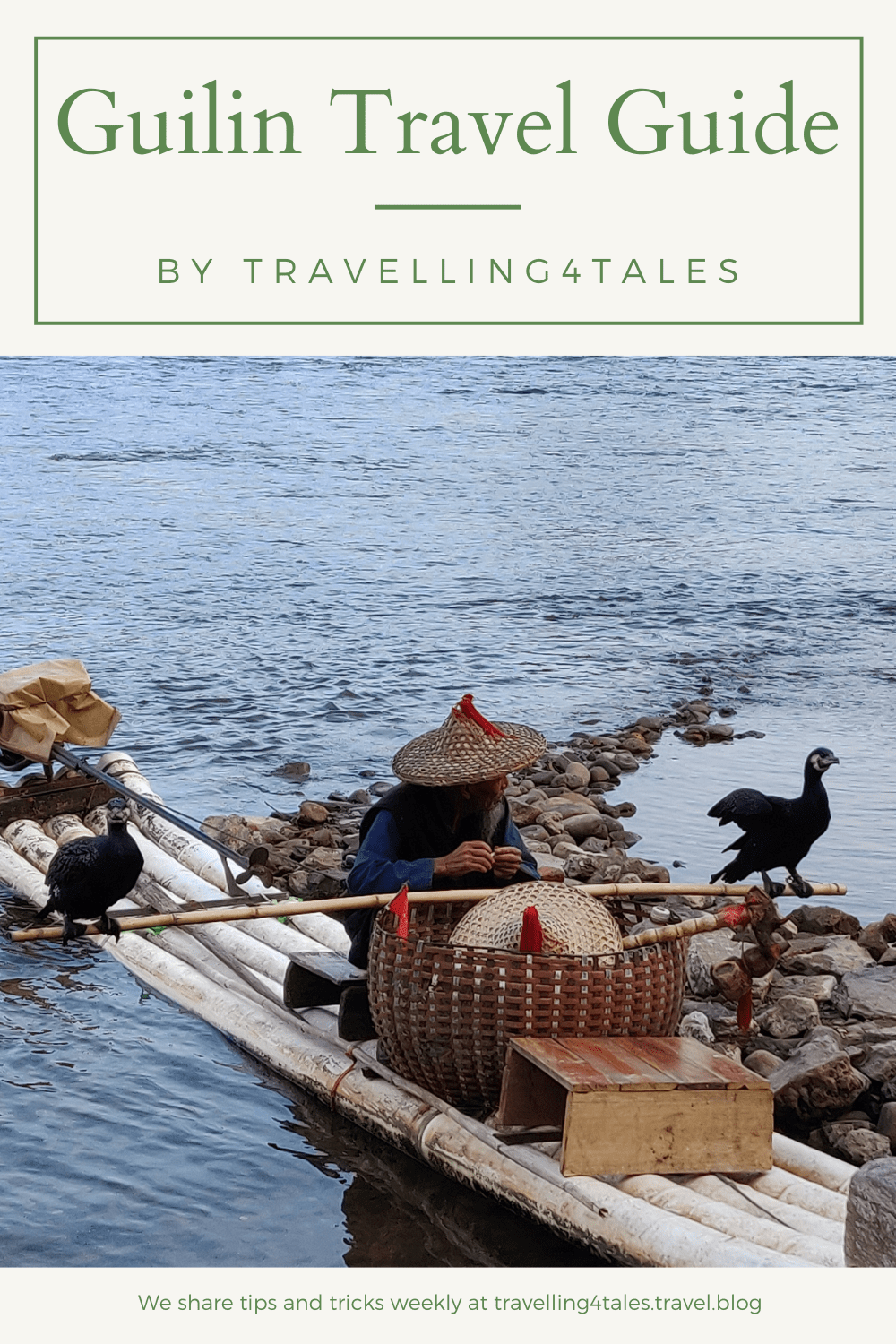
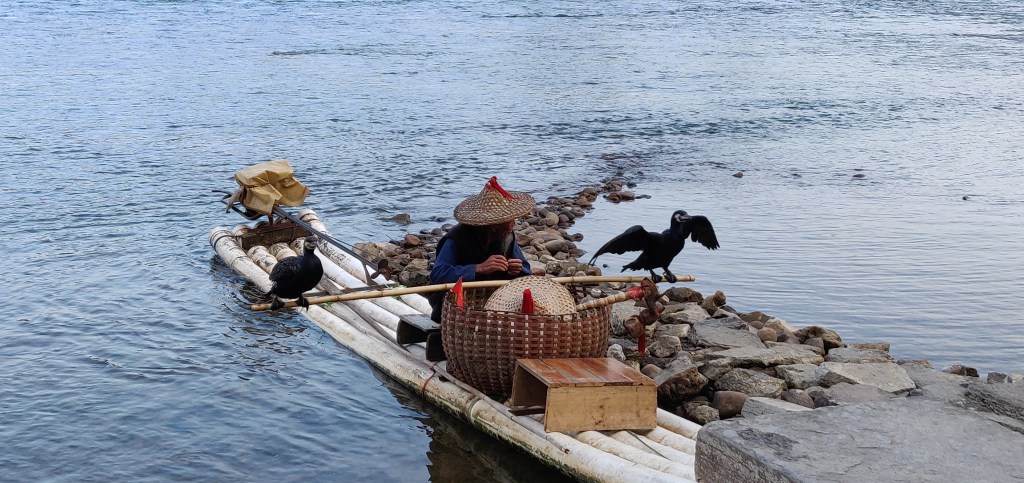
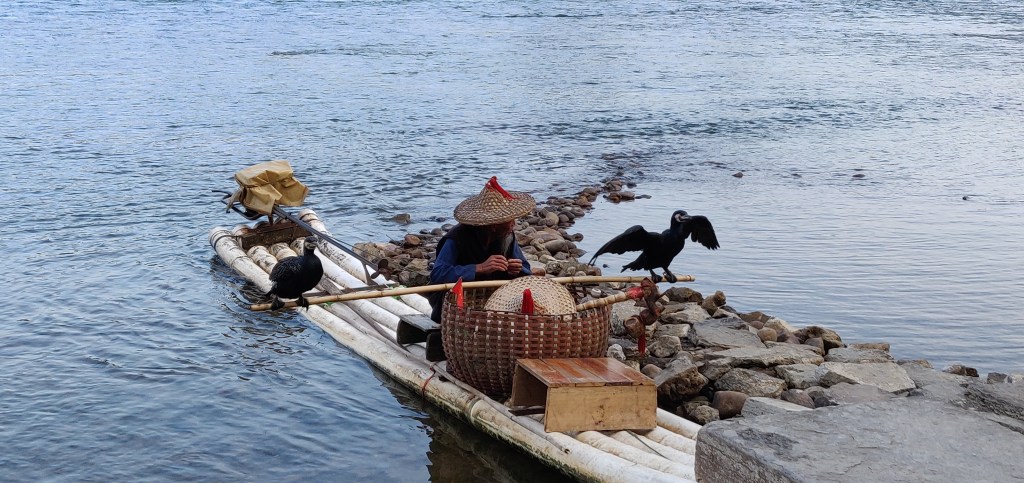
Cormorant fisherman on the Li River in Yangshuo: In our opinion, a very significative symbol of what happened to Yangshuo throughout the years and increased popularity
One of the most challenging things about our trip to China has definitely been finding vegetarian food, but we did find amazing places with enough planning. So, what was our strategy you might ask? Well, we read a ton of blogs, used Tripadvisor, and generally, asked very politely the chefs to make special meals.
One of our favourite vegetarian places when we were in Guilin it’s a place we found by sheer luck! We were walking around the town exploring random areas when we found a beautiful Buddhist temple selling some figurines. Ainhoa tends to always be attracted by shiny objects so we went into the temple and the shop. We then realized there was a restaurant right next to the temple sp, as we were super hungry, we decided to give it a try.
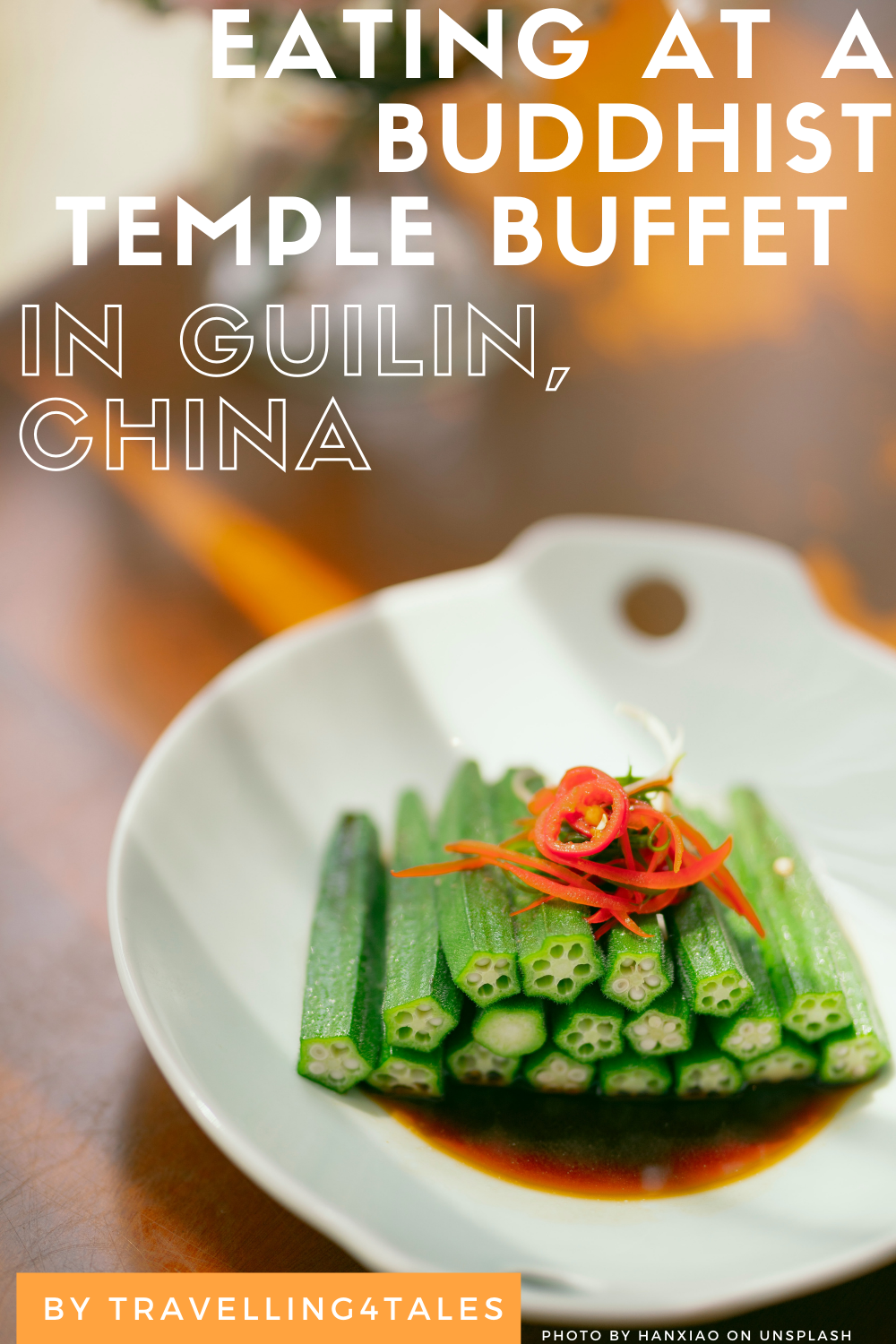
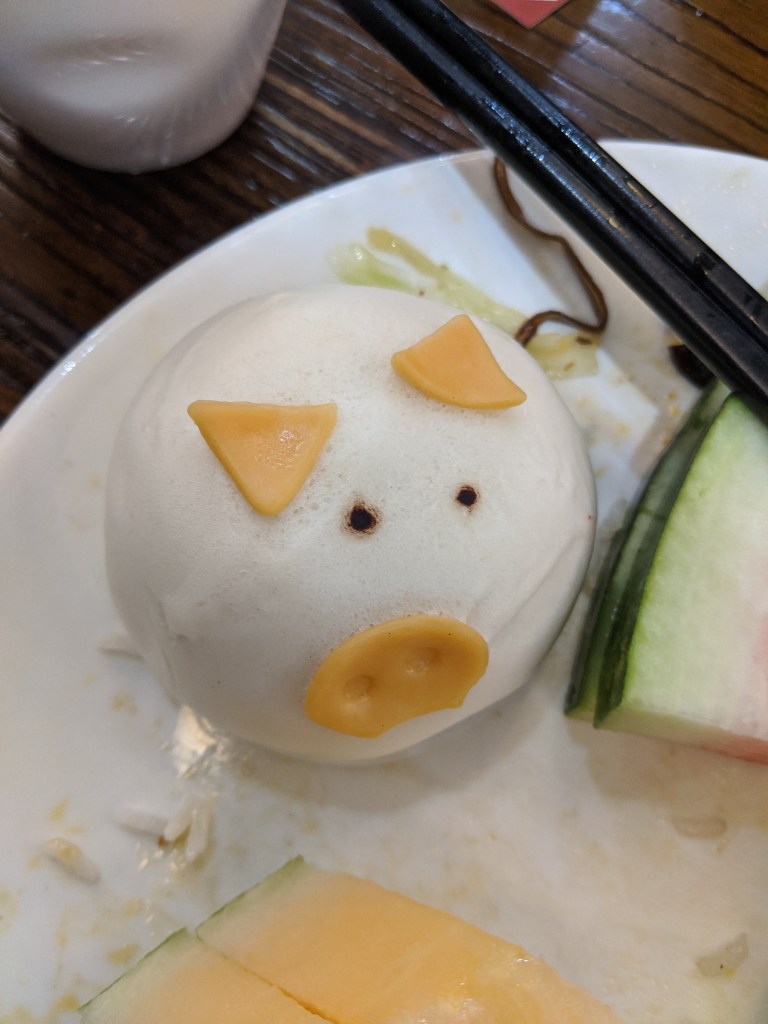
As we walked in, a cheerful girl gave us some indications about the place, it was actually a buffet and it was vegan! So, no animal products at all! She only asked us to please not waste any food, only to serve ourselves with what we could eat. We walked in and sat with a couple of locals (the seats are allocated so you might have to share but that is literally the best part) and started to get familiarized with the layout. There were different types of teas, water, vegan milk, and a huge layout of foods; from noodles to stew and even vegan sushi! At the very end of the line, there were sweet steamed buns and fresh fruit.
Literally the only photo I could take as we ate everything before I had the change, the food here was just delicious!
Another great delicacy we enjoyed was the “yaochai” or oil tea, a typical delicacy from Guangxi province made with camellia oil.
The food here was delicious and we literally ate there every night since we discovered it, we would definitely recommend you give it a try if you visit Guilin and you are not afraid of vegan food 🙂 at Nengren temple, Guilin.
The Dragon’s Backbone terraces or Longji rice terraces, located in Longsheng, a couple of hours from Guilin, are incredible structures crafted by the local minorities on the mountainside. There are many sections you can visit, depending on how long you have you can concentrate on one or you can stay overnight and get a more authentic experience.
In our case, as we were unsure on how to approach going to the Longji rice terraces on our own and how long we should spend, we booked a tour to visit them from our hostel. This was our day trip experience.
We got picked up from the hostel at 8:30 am, we got crammed into a tiny minivan, overfilled with tourists (mainly national) and a 2.5h journey to the village of Huangluo.
As we got out of the minivan in Huangluo we were flooded by traditionally dressed Yao women selling trinkets, also our driver kept trying to sell us tickets to watch a “Long hair show”. We knew it was just for tourist entertainment so we politely refused.
We walked around a bit, lots of retired Yao women set up stalls all along the village and were keen to sell anything to us. As we ventured further away from the main area, there were lots of new buildings (I assume for hotels) surrounding the village.
First stop of our trip: Huangluo where all tourist buses were dropping people off to explore the “traditional” Yao ethnic minority village
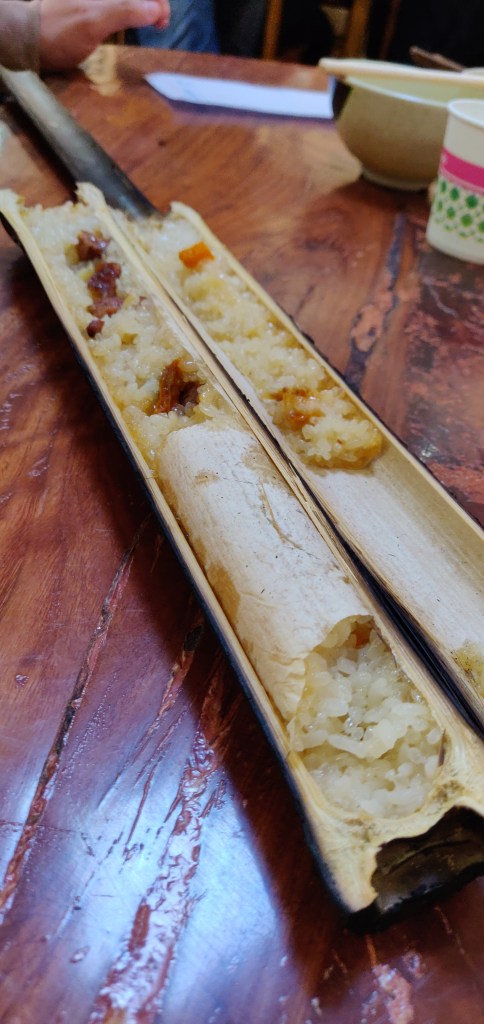
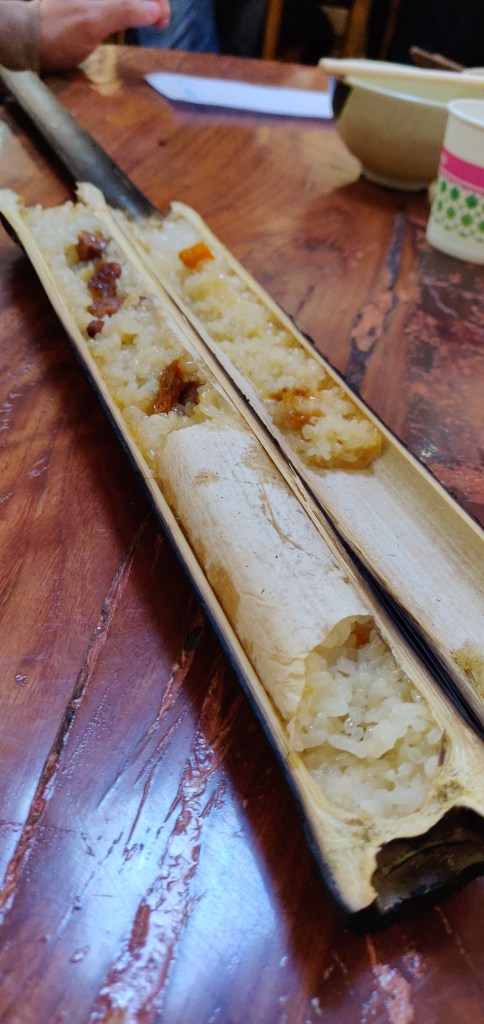
We walked back (you can literally walk the village in 5 minutes) and our driver told us to go for a lunch break with the rest of the tourists from our minivan. All restaurants were relying on the influx of tourists visiting the village for their income and so we went to one to try the traditional Bamboo rice; soft, fluffy rice cooked inside a bamboo stick. After lunch, we got back into our minivan and proceeded to travel to the Longji rice terraces.
Trying the traditional bamboo rice was definitely a highlight of the day.
Conclusion of Huangluo Yao minority village:
A tourist trap: The experience at the Yao village did certainly not feel authentic, we felt like we were there just to spend our money just before reaching the rice terraces, it genuinely felt like a set-up.
Longji Rice Terraces (Dragon’s Back Rice Terraces)
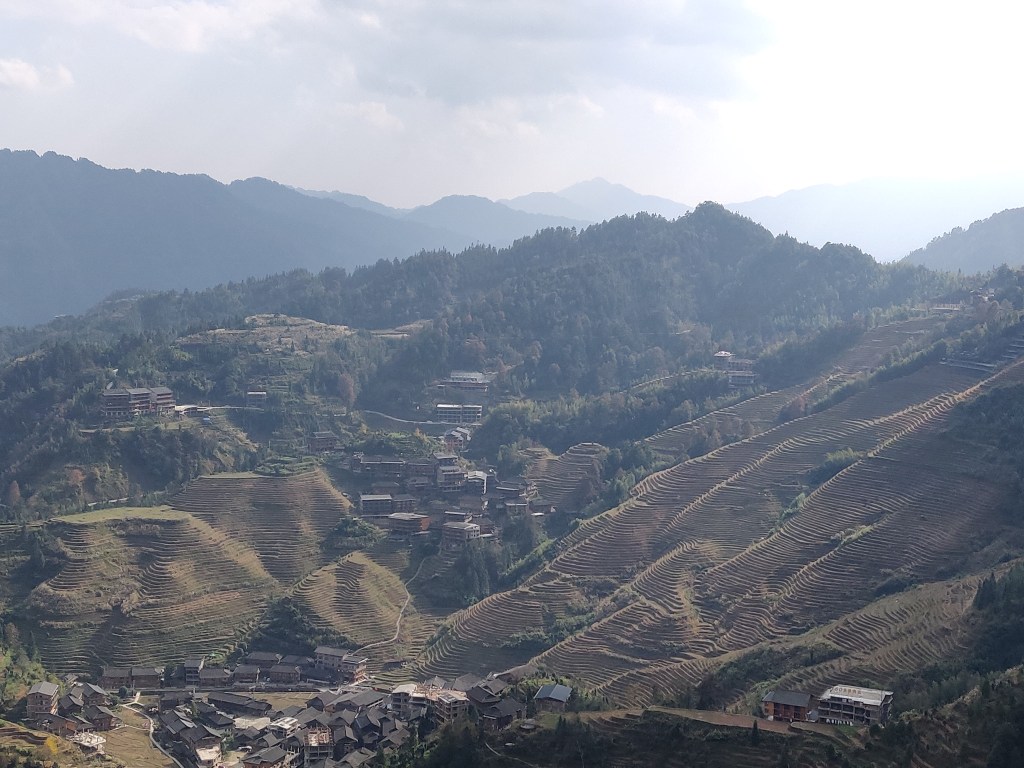
Only 30 minutes later, we arrived at Dazhai’s car park, northeast side of the Longji terraces scenic area. As we started walking up to the village we already realized it was way more authentic than Huangluo, there were chickens running loose on the steep stairs leading to the top of the many hills, children playing by their homes, and villagers walking by with fresh vegetables in baskets ready to be cooked for dinner. There are many routes to follow once you reach Dazhai, you can visit the Golden Buddha Peak (tallest peak of the scenic area, great views) or other areas of interest such as the Thousand-layer terrace or even smaller peaks that my translator could not translate. We opted for walking up to the Golden Buddha Peak (there is also a cable car but we do like a challenge).
The walk up wasn’t easy, it was hot, humid and we had a mozzie sleepless night before so we were already quite tired. As we were approaching we realized most people go up on the cable car and descend by walk. The whole walk up was 1h.
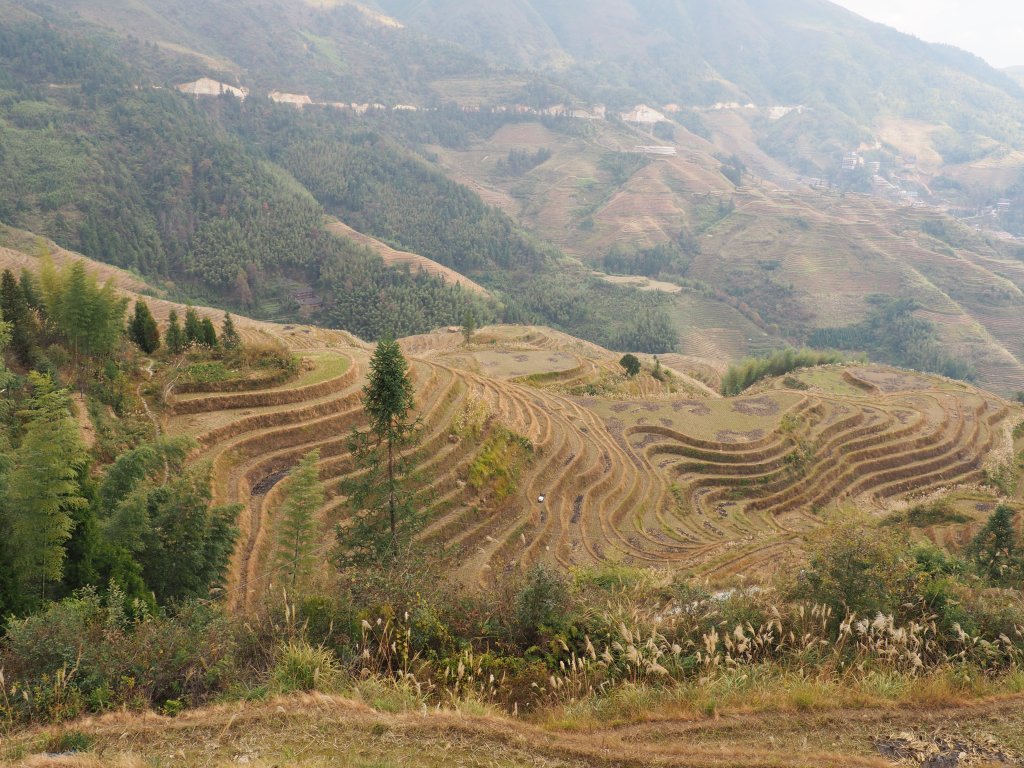
Once we reached the summit, we found another touristy set-up, you can hire ethnic minority clothes to take photos in front of the breathtaking rice terraces, you can get a professional photographer, you can buy souvenirs or, like us, you can just take it all in and take photos. We visited in November so it wasn’t particularly busy and the rice had already been harvested so the landscape was brown but still a beautiful and humbling to experience.
We walked back down and 3h back to Guilin.
The views from the top of the peak were just incredible, worth every step of the hike (sadly the new developments are also visible in the photo, but it’s just the sad reality when a place gains popularity)
Conclusion of Longji Rice Terraces:
We absolutely loved the experience of hiking up to the Golden Buddha peak and through Dazhai. Although there were new developments being built (probably hotels), the village was still quite traditional and the rice terraces were just incredible to watch, we were lucky enough to see them completely (no fog) although not in their green royalness.
Our regret was not doing an overnight stay at one of the less-visited villages so we could explore the west side of the scenic area over two days.
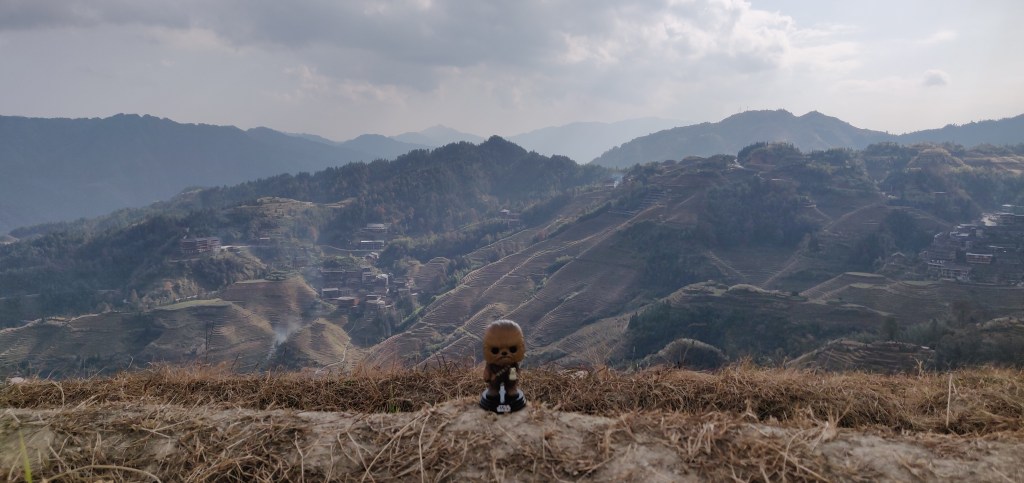
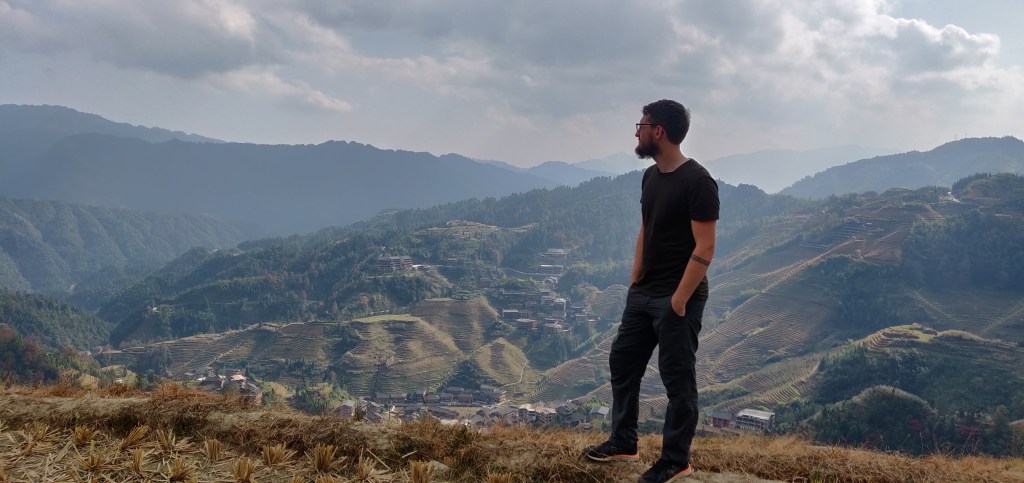
Chewie enjoying the views from the Golden Buddha Peak
Our excitement of boarding a Chinese bullet train was only matched by the anticipation of disembarking in a place renownedly known for having the “Most beautiful scenery under heaven”. Our first contact with this beautiful region was at 300km/h, all the lush green fields and karst peaks started to appear gradually as the train breezed through the lands. I remember thinking “China must have some of the most beautiful natural scenery in the world”. We arrived at our stop “Guilin West” from our Hong Kong train, we had studied the station and we were determined not to get lost. (You can study it too from this link). We got the local bus no 10 to the city center and the process was very straightforward; went in, deposited the correct amount into the donation looking box (make sure you have some small notes for this) and then sat down until our stop (they are written and announced in English).
We were in Guilin!
Often, we found ourselves reading blogs suggesting to skip Guilin and go straight to Yangshuo or Xingping, this is hardly fair. Although Yangshuo/ Xinping are definitely closer to the countryside’s breathtaking landscape, the Forest of Sweet Osmanthus (yes, that is what Guilin actually means) has some charm to offer too! If you have enough time we recommend not to miss Guilin (even if you only explore it for a day).
So welcome to our Guide to Guilin!
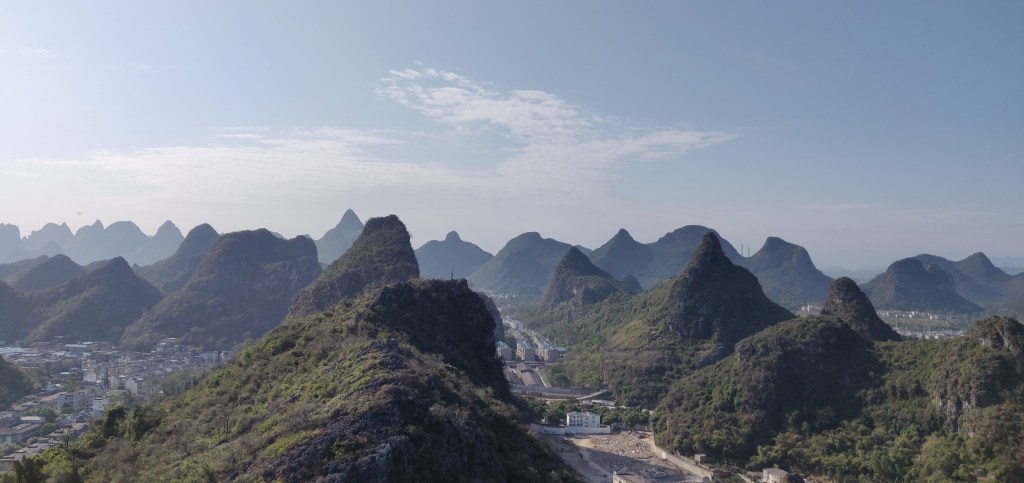
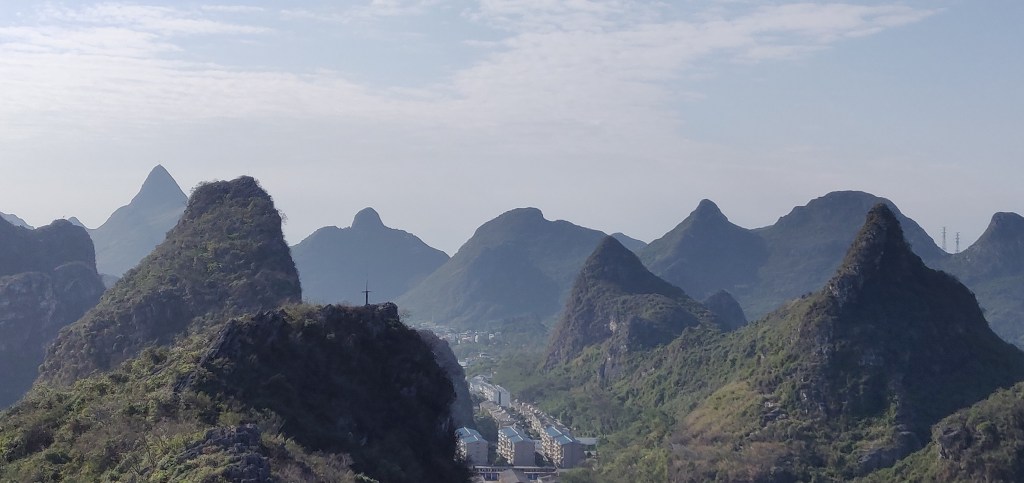
Views from the Old Man Peak in Guilin
Best time to visit Guilin
If you want to see Guilin and enjoy some good weather you should aim to visit sometime between April and October. If you plan to visit the Longji rice terraces, choose carefully as the landscape you will see is heavily dependent on the season. If you want to see lush green rice terraces you should aim to visit in May, however, if you want to see golden rice, you should visit in October. We visited in November and found the rice had already been harvested, it was a beautiful landscape anyways but we would have loved to have planned it before.
Longji Rice Terraces in November with rice already harvested
How to get in and around Guilin
Bus
From Guilin South bus station you can get a bus to Yangshuo or Xinping (around 25 RMB per person, perhaps a bit more to Xinping) Also from Guilin Qintan, you can get a bus to the Longsheng Scenic area for around 40RMB Travel in Guilin is easy, buses have both, English and Mandarin announcements and also the stops are written in English.
Train
The train stations are also well signaled so you should not have a problem travelling around Guilin (there are four train stations just in the town of Guilin so make sure to check which one you need, you can check it here (https://www.chinadiscovery.com/china-trains/china-train-stations/guilin-train-stations.html). You can get a train to visit the Chengyang Bridge by stopping at Sanjiang South and then getting a taxi to the bridge. You can also visit the ancient town of Huangyao by taking a train from Guilin North to Hezhou Railway Station and then a local bus to Huangyao. Alternatively, you can hire a bicycle to visit the sights around town, although we found the traffic in Guilin to be a bit chaotic with many electric mopeds taking over the road.
What to do in Guilin?
Li River
One of the highlights of not just Guilin city but the Guangxi region is the Li River, flowing all the way from the north of the Guangxi province around 80km and passing through Guilin city, Xinping and Yangshuo. When we visited Guilin, we absolutely loved walking on the riverside paths. Our favourite corner was just outside of the Park Hotel where musicians were playing traditional music, the sensation of peace was just so awe-inspiring!
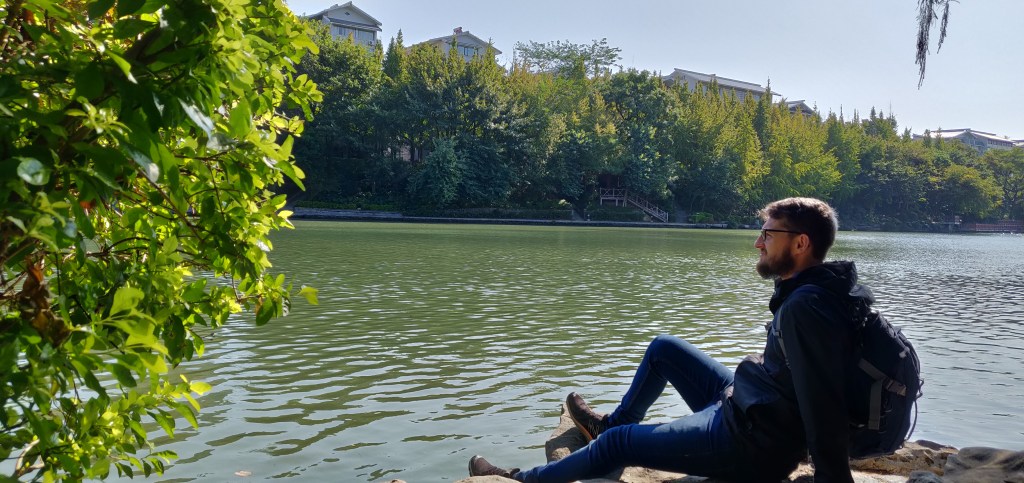
Chilling from our riverside walk along the Li River
One of the musts, however, if you come to Guilin is to take one of the Li River cruises. They provide you with the best option to see the scenery the region is known for in a day and to get away from the hustle and bustle of the city. These are the options they usually offer but you should totally shop around:
Three star boat tour (with pre-packed lunch) – Price around 350 RMB
This tour is quite complete, it will drive you to the pier by bus (around 45 min) and then you will spend 4h on the boat until you reach Yangshuo, you will then have some time to explore the town before you will be driven back to Guilin. In this tour you will be able to explore geographical features such as the Nine Horses Hill or the Snail Hill among many others, including the 20 RMB note spot.
Four star boat tour (with posher lunch) – Price around 700 RMB
Same tour as above but more comfortable seats and you can choose a seating area for extra price.
Cormorant fisherman in Li River in Guilin
Reed flute cave
Price: 90 RMB
Reed flute cave gets its name from the reeds growing outside, traditionally used to make flutes.
The best way to describe this wonder in our words would be “a natural cathedral looking rave”. Jokes apart, this cave also known as the “Palace of natural arts”, is a signature feature of karst geographic areas and it’s one of the most visited attractions in Guilin. Reed flute cave was even popular thousands of years ago during the Tang Dynasty. When you enter you will be dazzled by the breathtaking stalagmites and stalactites which are beautifully illuminated with multiple colours (we found this a very Chinese thing to do to a cave). We would definitely recommend this cave as a must see in Guilin.
How to get to the Reed Flute Cave?
As it’s one of the main attractions there are a few options to get there, if you are out on a sightseeing trip you can join the sightseeing bus from some of the other attractions such as the Elephant Trunk Hill or Seven Star Park, it runs every 30ish mins.
You can also get the citybus from most places in the city centre, it costs 1RMB per person, they are easy to ride and reliable. You can check the routes of Guilin buses here (https://www.travelchinaguide.com/bus-subway-search.htm)
Karst hills
There are multiple karst hills you can visit in Guilin, you can visit them all or pick a few. These are the main ones we recommend:
Elephant Trunk Hill -Price: 75 RMB
This flashy hill is a symbol of Guilin, it is easily accessible from town. Although it is a bit pricey it is quite a sight and it will provide you with a great photo opportunity.
Solitary Beauty Peak – Price: 120 RMB
This sharp peak is located within the Jingjiang Prince City, with your entrance ticket you will also be able to visit pavilions dating from hundreds of years back and there are multiple inscriptions within the complex that you can explore. As well as the peak and pavilion you can also visit the Peace Cave. We found this was one of the worthiest peaks to pay for, if you are on a budget we would recommend this one. When you reach the summit you will be able to experience one of the most beautiful views of Guilin.
Old Man Mountain – Price: Free
This is the only free peak you will be able to access in Guilin (city). The hike to the top is around 25 min long but reaching the top is challenging, if you do, however, you will be rewarded with incredible views of the city from above. This was definitely our favourite hill.
Incredible views from the Old Man Peak
Seven Star Park – Price: 55 RMB
If you visit this park, you will be able to see 7 hills and a cave for the standard price of Guilin’s other hills. Inside the 120 hectares park includes a bridge dating from the Song Dynasty (Flower Bridge). You may be asked to go with a guide, we managed to sneak past with just our ticket but that is something to have into consideration.
Other hills: There are some other hills in Guilin but we did not visit them, we found that they were quite pricey and it did not seem like there was much exploring to be, most of the time you are only allowed to walk up and then back down. This also applied to Elephant Trunk Hill but as it is such an unique we felt it was more worth the money.
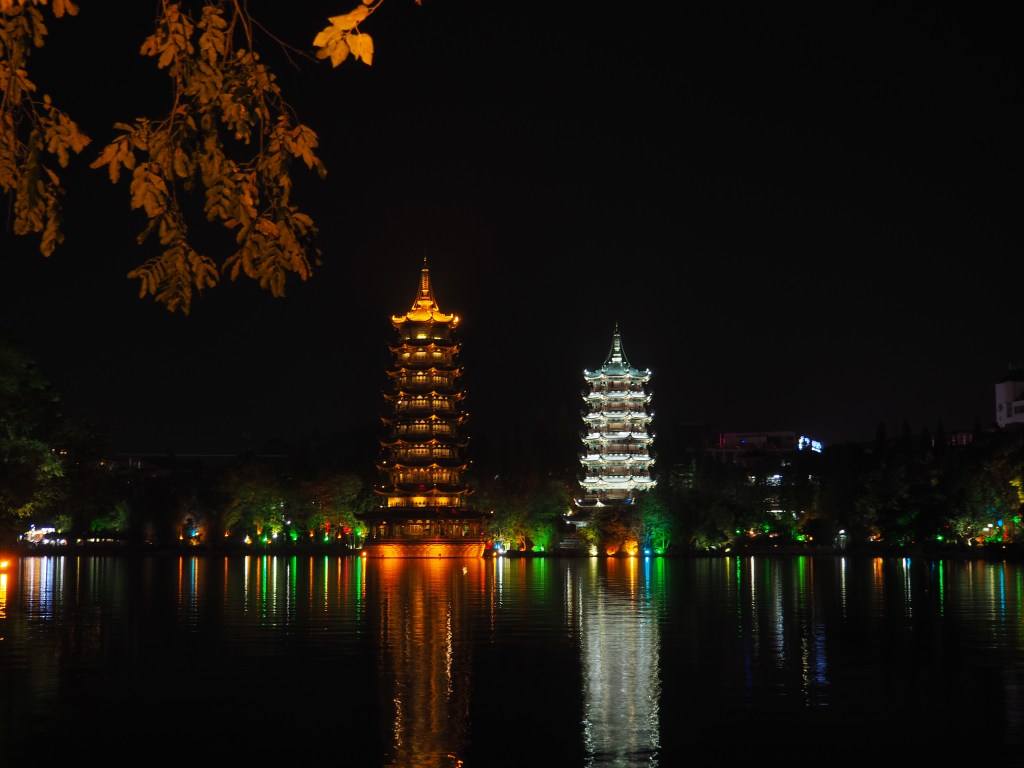
Visit the Sun and Moon pagodas at night
These beautiful pagodas are lit up in at night and they offer an incredible sight. Make sure to visit them before they close as you can cross them from an underwater tunnel!.
Sun and Moon Pagodas at night
Shopping in Guilin
Zhengyang Pedestrian Square Underground market
I admit it, this is perhaps not the typical thing you would imagine from the city with the most beautiful landscape under heaven but we found it quite an exciting activity if you have some spare time. The underground shopping centre is located in Guilin central square and you can find super cheap imitations, random tech and clothes, we thought it was something quite unique (but then this was our first time in China so perhaps not so much if you’ve already been to bigger hubs). We found some female Vans imitation shoes for £2! (after some amateur bartering)
If you like souvenirs and traditional crafts then the pedestrian market up Zhengyang pedestrian street is for you, here you can buy some traditional ethnic minority crafts, typical souvenirs and handicrafts.
What to eat in Guilin?
Guilin rice noodles You really can’t go wrong if you order this steaming bowl of rice noodles, the light broth is usually made with beef or pork meat and you will find it along with some vegetables, but if you want to take this dish to the next level you will have to add some of the pickled vegetables they normally offer as condiments. You will not regret it! You can try them pretty much at any restaurant in Guilin, we recommend Rice noodles pub in Guilin or Chong Shan MiFen (Yi Ren Road). If you are vegetarian but you don’t want to miss out on this delicacy, travel a bit further to Yangshuo and go to Mood Food Energy Cafe, you will find a great veggie option there.
Yummy vegan Guilin noodles from Mood Food Energy Cafe
Fried Chicken with Water Chestnuts This light dish is definitely a good choice at any time and you will find that water chestnuts will help your digestion.
Li River Fish Similarly to the previous dishes, you will find Li River fish everywhere either steamed (清蒸漓江鱼) or in soup, normally accompanied by ginger and tomatoes. Try them at Li River Cuisine Restaurant.
Stuffed Li River Snails Okay, for a Westerner this may be an unusual dish to try but if you are coming all the way to Guilin, you can’t leave without at least ordering it once. Normally stuffed with minced meat and mint, this dish will leave you wanting more! Try it also at Li River Cuisine Restaurant.
Tie: Bitter Melon and Egg and Stir-Fried Eggplant Two incredibly delicious vegetarian dishes you can order when you visit Guangxi, the eggplant is normally served in a tomatoey-chilly sauce. Yummy! You can find these dishes in many of the restaurants scattered around town.
Oil Tea Despite the name Yaucha or oil tea is a broth made of fried tea leaves. The traditional way of eating it is by adding small puffy rice balls which will fill with the tea, you can also add crunched peanut and salt. It is traditional for the Dong ethnic minority. Try it at Nengren Vegetarian Buffet (Just behind Nengren temple).
Fa Gao cake These delicious cakes are normally eaten by Chinese on special occasions but they are easy to find in any bakery. They are delicate in flavor and one will definitely not be enough.
Where to stay
We visited Guilin a couple of times within our trip and tried different accommodations to best suit our itineraries, these are our recommendations based on our experience and those of people we met.
Mid-range: ££-£££
Guilin Park Hotel: A bit out of the way but this doesn’t necessarily have to be a negative feature, it is located on the northwestern side of Guilin, just outside of the center and it is right next to the Old Man Peak and a beautiful riverside walk for your morning exercise, what else can you ask for?
Cheap: £-££
Ease Hostel: Clean and sleek decoration and very close to the center of town, do not trust Google maps to direct you, instead follow the actual directions and look for it on the map (it is on Nanhuan road) we had a riverside private room and the price was cheap for budget travellers.
Guilin Central Wada Hostel: Super close to Guilin Central Square, it is a very good choice if you really don’t like walking to the main highlights, it is also sparkly clean and the decor is modern and appealing.
Guilin Cyan Box Hostel: This one is further away, you can walk to the main attractions but it will take around 40 min, however, you will be rewarded with the most amazing staff of the whole Guangxi province and clean, spacious and super cheap double rooms (if I remember correctly just under £5 a night for a huge double room). If you still want to stay but don’t want to walk, the front desk staff will tell you which bus to get to visit the highlights, they can organize tours and they will even tell you the ACTUAL best eating and tourist spots. This hostel is also quite close to the Seven Star Park.
Get out of Guilin (Best day trips)
Longji rice terraces (Dragon’s backbone rice terraces) – Day trip but can be extended to overnight depending on where you go.
The Longji or Dragon’s backbone rice terraces include a large area surrounding the villages of Ping’an, Dazhai among others, they are incredible agricultural structures slowly shaped by the Longsheng ethnic minorities over generations, notably the Red Yao and the Zhuang.
We visited the Jinkeng rice terraces and hiked up to the Golden Buddha peak (although a cable car is available too) through an ethnic minority village. When we visited the rice had already been harvested and the atmosphere wasn’t as appealing as other seasons but the landscape was still impressive.
How to get to Longji rice terraces?
We booked our trip to the Dragon’s backbone rice terraces through our hostel but we have read you can do this independently. As we were quite new to travelling independently in Asia and due to the lack of Google maps to guide us we decided to chicken out from trying to reach it by ourselves. If you visit independently you will be able to choose what area to visit, you can find all the info for your choice here (https://www.chinahighlights.com/guilin/attraction/longji-terraced-field.htm)
Chengyang Wind and Rain Bridge
This covered bridge was built by the Dong ethnic minority in 1912, the wooden architecture of this bridge and the villages surrounding it is specific to this ethnic minority. When you visit the bridge, you will also be surrounded by beautiful countryside and villages.
How to get to the Chengyang Wind and Rain Bridge
Get a train from Guilin to Sanjiang (1h) and then get a bus or taxi from the train station stopping at Chengyang (you may need some translator app and/or GPS)
Huangyao Ancient Town
This beautiful traditional town is just full of attractions to visit, most of them free such as the Clocktower or the The Ancient Opera Stage among others, for us, this town was just a great day trip to soak up in traditional culture and architecture.
How to get to Huangyao?
Take the train from Guilin North to Hezhou and then a bus to Huangyao
Or take the bus from Guilin bus station direct to Huangyao
Yangshuo/ Xingping (recommended longer than one day but you can do it as a day trip)
Visiting Yangshuo and Xinping will offer you a better chance to see the karst splashed countryside of Guilin and to get away from the hustle and bustle of the city. Xingping will offer a more relaxed experience as Yangshuo increases in popularity. This was our experience of Yangshuo.
Bamboo raft over Yulong river
How to get to Yangshuo/ Xingping?
To visit either Yangshuo or Xinping you should go to Guilin bus station (the one at the south of the city).
Overview
Our overall experience in Guiling was actually great, we did feel like we were in a touristic city, however, most of the tourists in Guilin were actually national. We also found Guilin to be a charming city hub where you can actually base yourself to explore more local areas and other touristic spots. We personally do not regret visiting Guilin and actually found Yangshuo to be as touristic if not more, with a higher number of international tourists. Overall, Guilin has a very special place in our trip, blame the gorgeous food or the stunning landscape but we would recommend you to give the “Forest of Sweet Osmanthus” a visit!
One of the things we were most apprehensive when we decided to go on our (supposed to be) year-long travel was visiting China. The lack of available online resources we’re used to as well as the language barrier and culture shock was something that we thought would be a challenge to move around the country.
Although we only decided to visit the south, specifically Guangxi, we found China to be a surprisingly easy country to navigate and travel in!
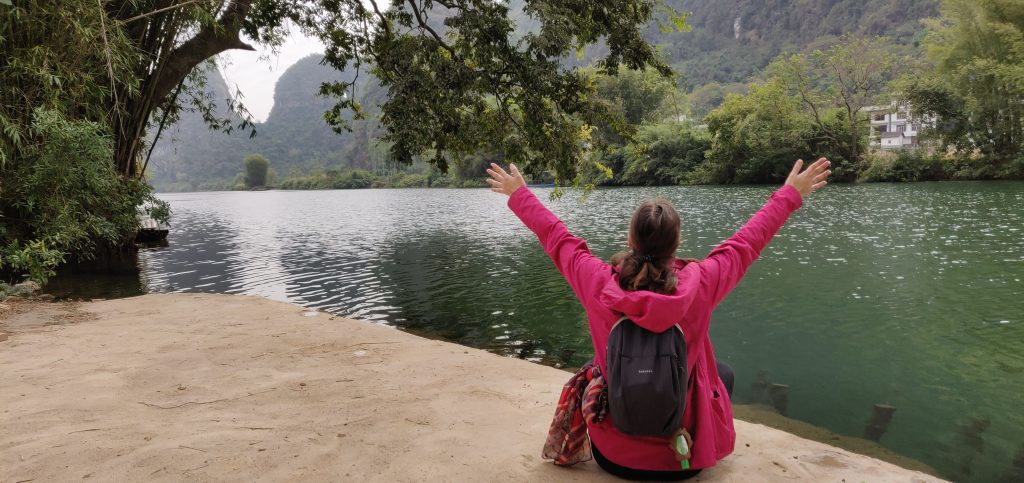
Happy and carefree cycling along the Yulong river in Yangshuo, China
Digital Resources
As we had travelled from Hong Kong, we managed to get China Unicom and China Mobile SIM cards from there that also work in Mainland, these cards allowed us to still be able to use our favourite apps (Google, Facebook, Instagram, Whatsapp, TripAdvisor) plus we downloaded a more reliable map app for China (Google Maps does NOT work) Maps.me.
Language barrier
Well, the available digital resources kind of made it easier to overcome the language barrier plus in tourist spots it was relatively easy to find someone with basic notions of English. It was, however, more challenging to try to understand labels, signs and menus. Translation apps don’t really translate non-Roman alphabets too well and mandarin are particularly notable examples of that! (Plus some things we just didn’t really expect to find in certain packages, such as chicken feet powder).
Cultural differences
Yes, we won’t lie, China did feel like a different world to what we were used to, as we had only travelled in Europe and the USA. For most of our time there we were in relatively touristic areas yet at times we did feel a bit out of place.
A great example was Yangshuo, an internationally touristic town had police in each and every nightlife club and pub. In fact, there is police everywhere, in banks, supermarkets, and every few kilometers on the street and cameras are also watching from above. We felt this police presence to be quite unusual. However, saying this, we always had good experiences with the police, in Guilin, we came into a bank with our big backpacks and a police officer gave us a chair and a glass of water because he thought we would be tired of walking with heavy bags!
Another shock for us was the food, Ainhoa is vegetarian (flexitarian, if she needs to she would be willing to eat fish) and it was not that easy the first days until we knew where to expect to find vegetarian food and to what level (most of the time, broths won’t be vegetarian). We relied on bakeries a lot and supermarkets and, in the end, we got brave enough to order at traditional restaurants.
With all this in mind, Chinese people are very welcoming and helpful, even if they didn’t understand and couldn’t talk to us, they always tried helping us or found someone who could.
Overall we found travelling in China with resources to be a very enjoyable and stress free experience and we are already planning a longer trip to this beautiful country (after the COVID-19 pandemic is over, of course).
China is a country of myth and mystery, incredibly vast and diverse, a country full of wonder. Here you can find technological hub cities, ancient forests, mountainous regions, and beautiful seaside resorts. With eight major geographical regions with distinct cultural characteristics, it is also certainly not an easy country to draw an itinerary for. For this reason, in our trip, we decided to concentrate on the South, more specifically the autonomous region of Guangxi.
Guangxi autonomous region is very scenic, dominated by karst peaks and the stunning Li River and the famous Longji rice terraces. I decided to nickname this region the wanderlust capital of China after being drawn to visit it from the many photos of the karst formations of Guilin and Yangshuo. I am sure you have probably already come across the photo of the cormorant fisherman on the Li River, and this region certainly does not disappoint.
A bit of trivia:
Guangxi is the province in China with the largest population of ethnic minorities. The Zhang ethnic minority is the highest represented in the region but there are also Yao and Hmong among others.
Wang Zheng Gong, a famous Chinese poet described Guilin’s scenery as “the most beautiful under heaven.” So much so, it is actually one of the most visited places in China.
The RMB 20 Yuan Note portrays a scene of a fisherman floating along the Li River, this scene is situated on a river bend just outside of Xingping.
These incredible rice terraces get their name from the topography of the area, emulating a dragon’s back. Sculpted into the mountainside by the Zhuan people, their construction started during the Yuan Dynasty (1271-1368) and are still active to date, mainly used by the local ethnic minority communities. They are easily accessible from Guillin from the Guilin Qintan bus station (for up to date information you can check https://www.chinabusguide.com/) or you can go with a tour from your accommodation.
If you wish to visit the rice terraces (and you definitely should) bear in mind that the landscape will dramatically change seasonally. You will find deep green fields in the summer (May-June), in the autumn you will find golden rice ready for harvest (September – October) and in the spring you will find a mystical water reflection landscape as the paddies are flooded from the seasonal rains, in the winter.
Beautiful views from the Golden Buddha Peak
2. Yangshuo’s countryside
Price: Free
I will be honest here, when we first arrived at Yangshuo town from our 1h bus ride from Guilin, we did feel a little disappointed. Imagine a toned down version of Khao San Road in Thailand with beautiful scenery around it and traditional chinese buildings. However, our accomodation was situated quite far away from all that, in quite a local area near a fresh produce market. On our second day in Yangshuo, we took our bikes and decided to go see what the hype was all about (and it did not disappoint). The countryside in Yangshuo is just beautiful! The bike path took us along the Yulong river through allotments and rice fields surrounded by the most magical vegetation blanketed karst formations. If you want to follow our itinerary ()
Yangshuo also offers great hiking opportunities such as the TV antenna hike and there are plenty of climbing companies if you are into adventure activities.
Stunning karst formations in Yangshuo’s countryside
3. Li River
Price: Free to walk, boat cruise prices vary (around 350 RMB/person for a basic one)
I could describe Guilin as a fully functional city, with a solid metropolitan bus connection to the many different parts of the city and a strong commercial outlook but the touristic side of the city is definitely very present. Guilin offers many different touristic features such as the Sun and Moon pagodas, Reed flute cave and many karst peaks.
Our favourite activity in Guilin, however, has been the river Li. You can experience the river in many different ways, there are lots of tour companies that offer river Li cruises which is a great way to also get a very good sum-up version of the karst topography of the area, but you can also explore it by walking which has actually been our favourite way. In Guilin both orillas of the river are paved and there are bridges crossing it and the scenery is very peaceful and relaxing, along the way you can even find locals playing traditional music.
Cormorant fisherman by the Li River
4. Chengyang Wind and Rain Bridge
Price: 60 RMB (not including transport)
If you are interested in China’s ethnic minorities, a trip to visit this bridge will definitely not disappoint you. The Chengyang area is home to many Dong ethnic minority villages that you can visit and stunning countryside. The Dong are particularly known for their woodwork and building structures of which this bridge is a notable example, take your time and admire both the intricacy and at the same time simplicity of the design, apparently it was built without a single nail! The best way to reach the area is by train from Guilin, the train will only take around 45 min to Sanjiang South where you can take a taxi to the bridge.
5. Detian Waterfall
Detian waterfall (China)/ Ban Gioc waterfall (Vietnam) is a bit out of the way if you are following the tourist trail on Guilin/Yangshuo/Xingping but it is definitely worth a stop if you are going south. It is the largest waterfall in Asia bordering two countries. These falls drop around 60m and they are around 200m wide. You can see both parts of the waterfalls from the Chinese side.
What to eat
Food in China is as diverse as its geography. Guangxi is particularly known for its proximity to Cantonese cuisine. You will find hearty noodle soups, the ubiquitous Chinese street snacks but also delicious dishes where fish and meat are the protagonists. One half of travelling for tales is flexitarian (95% of the time vegetarian and 5% pescatarian) so it is always harder to find the local cuisine for her. One of the best non-veggie dishes we have tried are the Guilin noodles, if your diet is not restricted then you will probably should try any of the Li river fish dishes (Yangshuo beer fish, Li river snails, etc) and chicken and water chestnuts. For more specifics in food follow our advice for Guilin, Yangshuo and Nanning and “How to eat vegetarian in Guangxi?”.
Traditional Bamboo Rice from the Red Yao village of Huangluo, Guagnxi
How to get in and around Guangxi
Train
Moving around in China is not as complicated as you may think, there is a very convenient and reliable railway system that connects most major cities
Also, the staff at the railway stations is extremely helpful, approachable and, although they may now be able to fully communicate, they will go out of their way to try (download a translator app, it will save your life).
As we were new to backpacking and a bit apprehensive about our travel in China we used China DIY travel and they were extremely helpful and easy to use (not an add, I promise) but after 4 months travelling we feel we could have done it ourselves..
Bus
We found there were buses available for anywhere you could want to go to Guangxi. The stops in the city buses were clearly marked and announced in English and if you look a bit lost people are very keen to help you out.
Metro
Metro is available in bigger cities, on our trip, we only used the Nanning Rail Transit (NNRT). The system may differ slightly from other metros you may be used to, in Nanning you must first pass through a metal detector and may or may not be checked by the official in charge. Then you must purchase your token in one of the ticket booths or machines. You scan the token to get in and upon exiting you will put it inside the slot.
Air
There is an airport in Guilin, Liangjiang International Airport (KWL) with regular buses to the centre. Also from Nanning, the Nanning Wuxu International Airport has multiple bus connections to the city centre.
Tips and tricks
Do I need a visa to travel to China?
If your nationality belongs to any EU country or UK you need a visa to travel to China. We are Spanish/British and the route for both was easy.
Follow their step by step guidance that will direct you to the best route to apply for a visa. In our case, we just filled in the form for the tourist visa.
After that, you will have to attend an appointment in the visa application centre of your city of choice. All you need to remember is to bring the printed documents, your passport and a copy, your itinerary (booked hotels of half of your stay) and your route of entry or exit.
In our experience, we didn’t have a route of exit so we had to explain all our itinerary and have bookings of hotels for our onwards travel (which was Vietnam). The more evidence you have the best in these cases.
If you live too far away from any of the visa application offices you can also apply by post by providing the same documents but you will have to send your original passport.
Money
Currency
China uses the Chinese Yuan (CNY or RMB), we mostly relied on cash but we did use an ATM in Guilin (Agricultural Bank of China) and we did not get charged any commission from the bank. However, make sure you take with you a card that does not charge commission to use the card abroad or to use a foreign currency (we use Starling or Monzo)
Budget
We believe you can travel to Guangxi with a budget of 40 GBP/ 45 EUR. We consider ourselves mid-range travellers and our spendings were:
Accommodation: An average of 8 GBP / 9 EUR per night in Guangxi on private double-bed hostel rooms.
Food: An average of 16 GBP / 18 EUR in food (breakfast is normally included in accommodation) including some western meals.
Activities and tours: We only did one tour during our stay in Guangxi, so this was not a big expenditure for us. We mainly hired bicycles and enjoyed the free sights.
How to stay connected
If you want to stay connected when you travel to China we recommend you get the Holafly SIM card, it already includes a VPN so you can still use your favorite social media apps. https://holafly.com/products/sim-datos-china
As we had travelled from Hong Kong, we were lucky enough to find out that if you buy a China Unicom SIM card that also works in Mainland China in HK you will be able to use it in Mainland China without the need of a VPN. We didn’t know about this before starting our travels.
How to be safe in Guangxi
Guilin and Yangshuo are the two spots more likely to encounter scams and petty crime. By any means, we did not research all scams before we visit a location because scammers extremely creative and you will always find one unheard of but following some rules of common sense will help you avoid some of them at least.
Never trust anyone offering you a tour on the street, especially if they start the conversation with “Where are you from?”. We had this happen to us a few times, if you want to do a tour you will always get the best prices from your hostel or a reputable company. You can always check reviews for tour companies on Tripadvisor.
Be wary of people taking you to a teahouse to practice their English, you will end up paying all the bill (and it won’t be cheap).
Always choose a taxi with a meter on and insist to the driver if they don’t want to turn it on. If you need to take a taxi with no meter, negotiate before you go and always take your luggage out before you pay. We heard stories of unlicensed taxis leaving with people’s luggage.
When you rent a bicycle/ motorbike, do not leave your passport as a deposit, we tend to never leave our passport as a deposit in any country we go to (not even in hotels) anyway. We normally take photocopies of the passport if they insist. And always take photos of the damage marks etc already on the bike/motorbike beforehand just in case.
Recommended Apps
China is notorious for its Great Wall, and not just the physical one. The Great Firewall of China makes it extremely difficult for you to use your favourite websites and navigation/ translation apps. This are some tips from our experience:
Download maps.me, Google maps will 100% not work in China (everything is out of place) so an offline map app will be more reliable.
Download Pleco, you will be in situations where you won’t be able to understand/speak to people and you will be missing out if you don’t try, Pleco works offline and it has been super useful for us (even when we got lost in the middle of the countryside and tried to ask a villager how to get back).
Overview
Guangxi is an incredible region of China to explore, we can go as far as to say its a great place for China beginners as it’s quite a touristic area (particularly Guilin, Yangsuo and Xingping) and very accesible by public transport or tour. As our first taster of China, Guangxi has left us wanting more! So we will definitely be planning more China backpacking in the future.
We started our journey, like many others, in London. We sold most of our life, packed a small (probably not small enough) fraction of the rest and we are waiting, all jittery to board our direct flight to Hong Kong.
12 hours later and after a few too many glasses of British Airways quality Sauvignon Blanc, we land, the door opens and we get this slap of heat, humidity, and a soothing sea smell, we are in Hong Kong!
Our first impressions of the city, very influenced by our choice of accommodation, was not love at first sight. We have done our research, we embark on bus 21 to Tsim Sha Tsui and excitedly await the sights of the city. We arrive at the chaotic and contrasting Nathan Road where you can find the poshest shops right next to very grubby looking emporiums. We find the entrance “Tsim Sha Tsui Mansions”
We arrive to our room which consists of a tiled square with a bed and a tiny washroom, the fan (which is essentially our window) seems to be fanning into our room the lunch smells of everyone in the block and the person next door seems to have a phlegm problem. We are in the city! (SPOILER: Despite the first impression, we fell in love with the city)
Entrance to our accommodation in Hong Kong on Nathan Road
What to do in Hong Kong?
Hong Kong is a bustling city full of opportunities for everyone, from shopaholics to nature lovers the city has a choice for you. In no particular order, here you go!
1. Walk around the Avenue of Stars
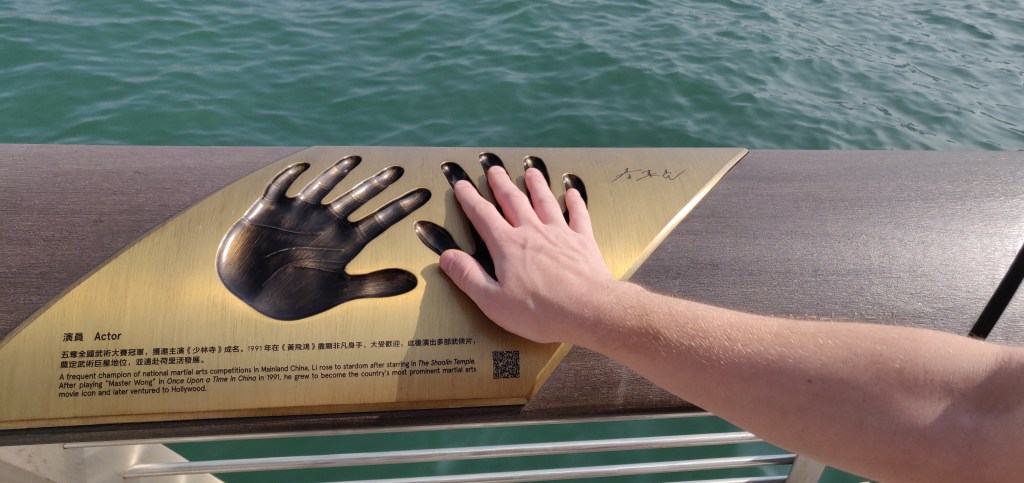
The Avenue of Stars located in the northern side of Victoria Harbour at Tsim Sha Tsui, it can only be compared to Hollywood’s Walk of Fame celebrating stars of the Hong Kong film industry such as the legendary Bruce Lee, the kickass actress that is Michelle Yeoh, Mr Jackie Chan himself plus many many more.
Pete and Jackie Chan practising at the Avenue of Stars
The Avenue of Stars was first opened in April 2004 containing 73 handprints and 4 bronze statues, one of which is Bruce Lee, the project itself cost HK $40 Million to construct.
We walked through the avenue of stars pretty much everyday whether it was to get to the place we were heading in our case was the Symphony of Lights (read further to hear about that) or to get the MTR or even just to go for a walk along the river. Basically no matter what you do at some point you will end up on the Avenue of stars but that’s not a bad thing, with so many cafes, restaurants, shops and places to sit and admire the view you could easily spend a good part of the day here.
Hand-prints of actors line up the handrails of the Avenue of Stars’ promenade
2. Watch the Symphony of Lights
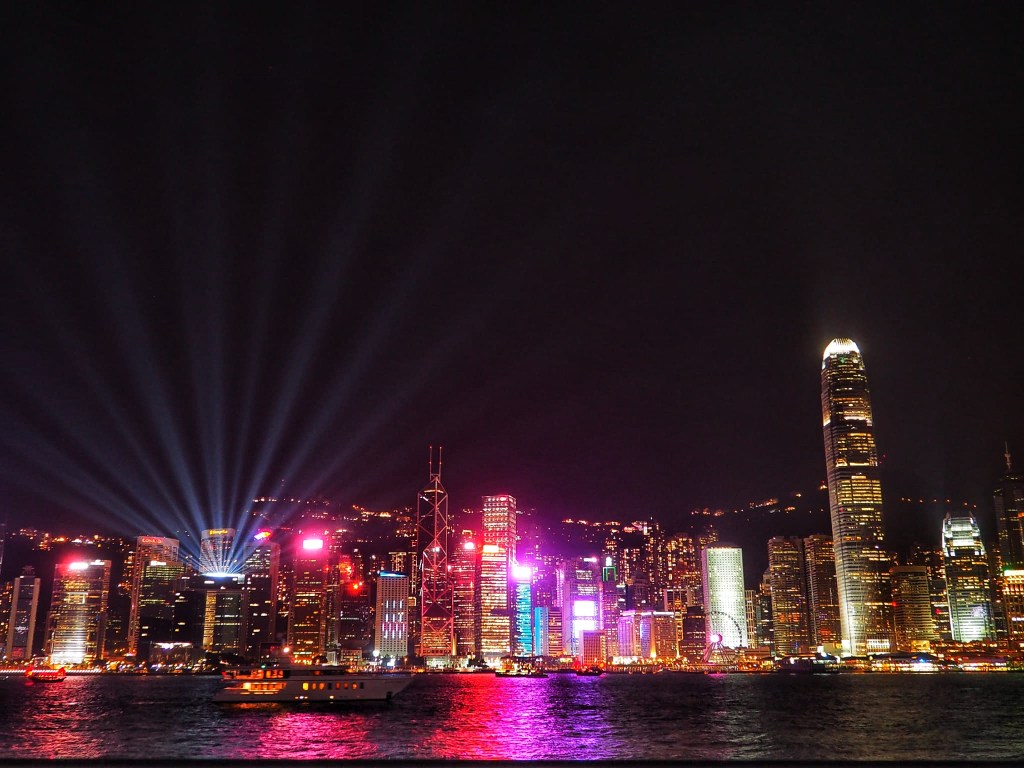
The Symphony of Lights is an amazing light and music show that involves more than 40 buildings synchronized to a song composed for that purpose. It has been entertaining visitors and locals equally since 2004. Before you go, you can download the app to plug your headphones in and immerse yourself in the moment but you can also (if you watch it from the spot below) listen to the music live.
Best place to watch the Symphony of Lights:
The best spot to watch it is either at the elevated platform right next to the Hong Kong’s cultural center where the music will be played, or if you want to have a more intimate experience you can go just underneath the platform where there are considerably fewer people and you can get very cool water reflection shots, however to be honest you could walk all along the the avenue of stars and still see the light show. We went there every night so we tried it all!
Make sure you get there at least 30 min before (the show starts at 8 pm) so you can get the best views, just buy some food and drinks and enjoy the incredible skyline views 🙂
Hong Kong’s skyline illuminated during the “Symphony of Stars”
3. Climb to “The Peak” (Victoria Peak)
How to get here?
Getting to the Victoria Peak Observatory (located at the top of a shopping mall) is easy, there are many options:
You can walk up to the peak observatory and even combine it with using the longest escalator in the world (read further to hear about our failed attempt at that). You can start from Central. If you chose this option all you have to do is follow the “Old Peak Road”. (See map below)
Get a bus. This route will offer you a different view, overlooking the houses of the wealthiest of the city. The bus to get is the 15 from Exchange Square Bus Station.
Take the tram. This option is the most touristy (thus most expensive) but it is quite fun. We only took it because when we visited, the buses were not running and we had limited time. Apparently, we were quite lucky because the queues can take hours!.
What to expect?
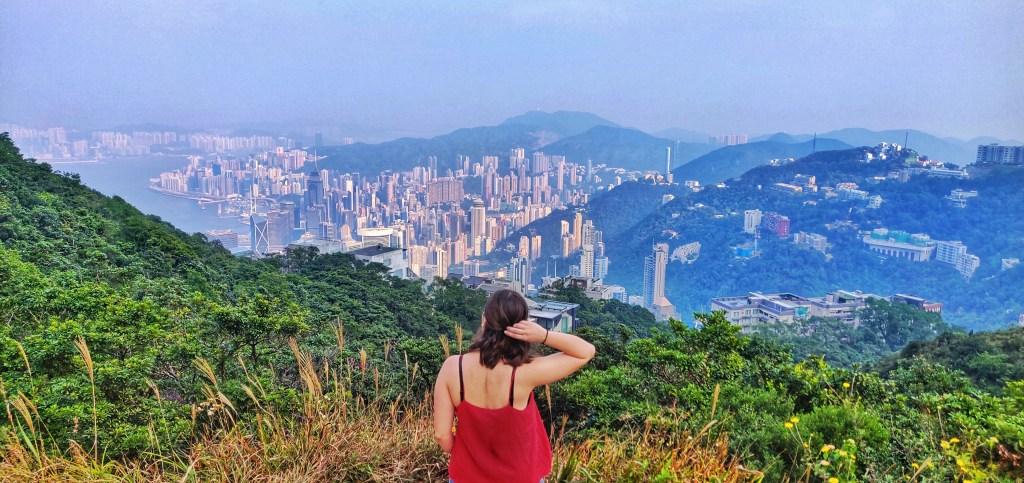
Once you reach the top, you will find a huge shopping mall, we did go up to the top but we did not pay to visit the observatory. Instead, we took photos from some of the open areas at the top next to the entrance to Wildfire restaurant and next to the entrance to Burger King. We then went outside of the mall to walk around the paths. Seeing those two viewpoints took less than 30 min so we decided that we wanted to try and reach the actual peak and visit the Victoria Gardens. We were not disappointed.
How to reach the summit of Victoria Peak:
From the Peak mall follow Austin Road until you reach some building blocks on your right, then turn right to carry on following the road.
Carry on following the road uphill until you reach a fork, then carry on the path on the right until you reach the top of the hill. As the trees dissipate you will already start to see the amazing views.
On your way back you should check out the Victoria Gardens and follow the Governor’s walk, it is a beautiful path surrounded by nature.
Note: The hike up does require some level of fitness as it is quite a steep hill. We did see some people going by taxi to the gardens but we did not see anyone reaching the peak, it was only us and another couple.
Quiet spot near the summit of Victoria Peak
4. Hit the parks
As a busy city, Hong Kong has managed to create amazing spaces for relaxation and break from the hustle and bustle. Both Kowloon and Hong Kong parks are must see spots in the city.
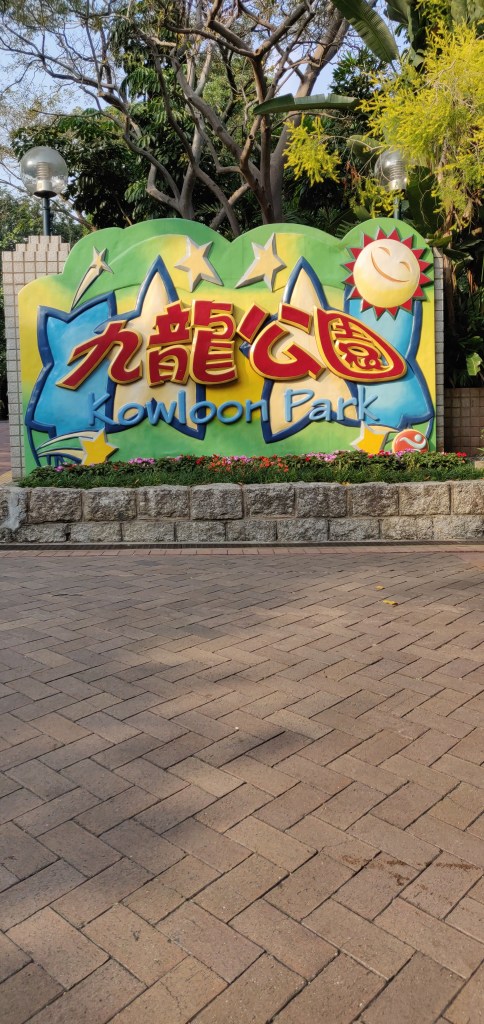
Kowloon park
Situated in Tsim Sha Tsui, Kowloon park used to be used as an army fortress and it was only in the 70s when it became the tranquil space it is now.
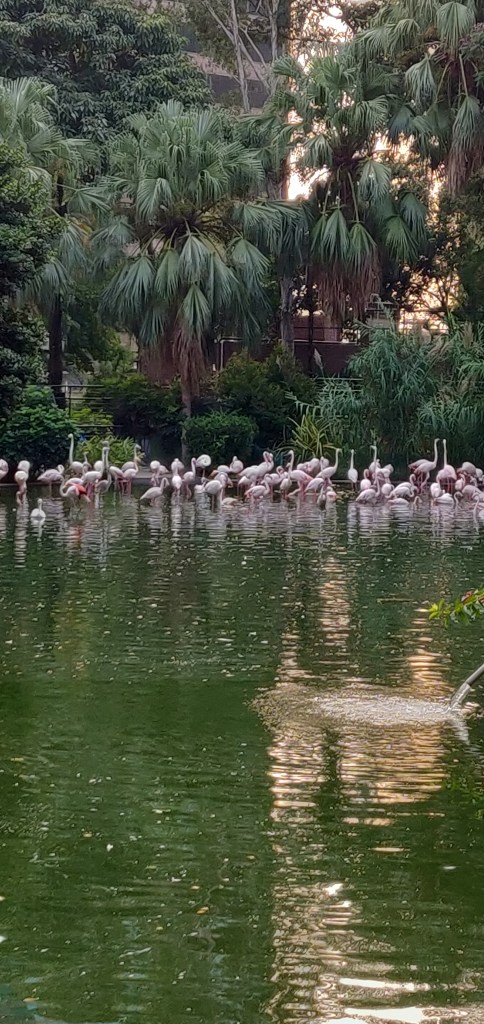
The highlights in Kowloon park are the Banyan Court, Chinese garden, Aviary (showing different species of birds from all over Asia) and the bird lake, which is guarded by beautiful flamingos. Just outside of the park you can find the Hong Kong Avenue of Comic Stars.
Entrance to Kowloon Park
Flamingos at one of the ponds in Kowloon Park
Hong Kong Park
This park contains a number of historical buildings from the British colonial rule, built between 1842 and 1910. It also hosts the Museum of Teaware, which is free to visit and contains interesting information about the different tea types, ceremonies and ancient teapots and cups.
Also, the Olympic Square stands proudly in the centre of the park.
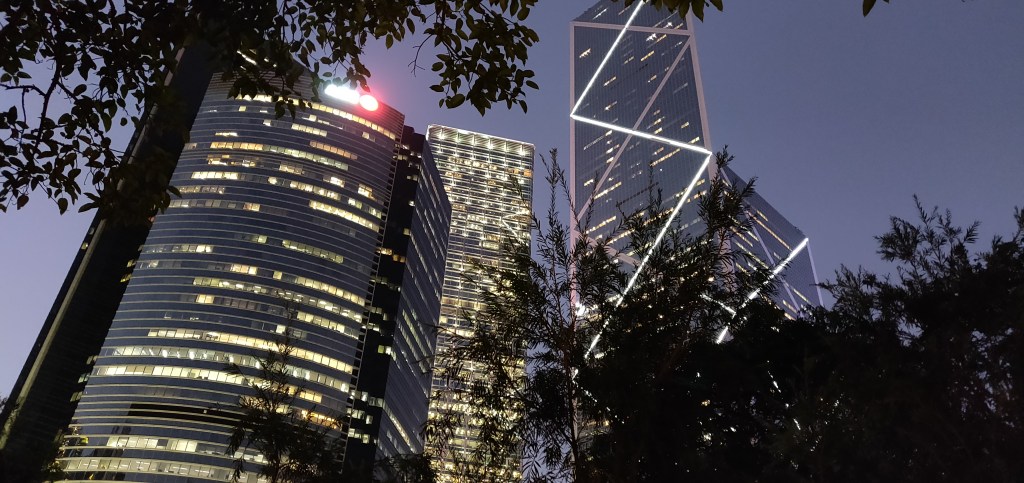
When we visited (at sunset) we had the chance to walk past the stunning waterfall in the centre of the park to watch the skyscrapers of the city turn their lights on and it was probably one of our favourite views of Hong Kong.
Sun setting at Hong Kong park with the huge skyscrapers just starting to light up
5. Ride the longest escalator in the world
Okay, we are going to explain how to ride the longest escalator in the world without failing like we did.
Costing HK$240 million (£24million) and built in 1993, its purpose was to provide a sustainable mode of transport from central to mid-levels. The system includes 18 escalators and three walkways and will take you around 20 minutes from bottom to top or vice versa.
If you wish to visit the world’s largest escalators you can actually combine it with visiting Victoria Peak. How? You say.
Well the escalators run on a very clever time system, they are in fact one way running escalators so from 6:00AM until 10:00AM they are running downhill in order to get everyone who lives in the mid-levels to central for work. Then from 10:00AM until midnight they run uphill, obviously to get everyone back home after work.
If you wish to take advantage of this and see Victoria Peak as well as ride the escalators follow these steps.
1st head to the escalators anytime after 10:00AM and take a ride up and take in the fact you’re riding the world’s longest escalators (there are shops and restaurants on the way up, so you can easily hop on, hop off)
2nd once at the top you can continue up the hill until you reach Victoria Peak (it is a steep hill but worth it, just bring some water).
3rd when you’re ready to come back down, the peak actually offers a cable car to the bottom, which has some incredible views.
Now for the part where we failed. Not knowing these times for the escalators we rode the cable car UP to the top then decided to head down the hill by foot to reach the escalators only to find out they are on there uphill motion, which resulted in us having to walk down an unhealthy amount of steps.
So everyone if you do wish to see these escalators then DON’T do what we did, just follow the three steps listed above and you will have a cracker of a time.
6. Visit the Ten Thousand Buddhas Monastery
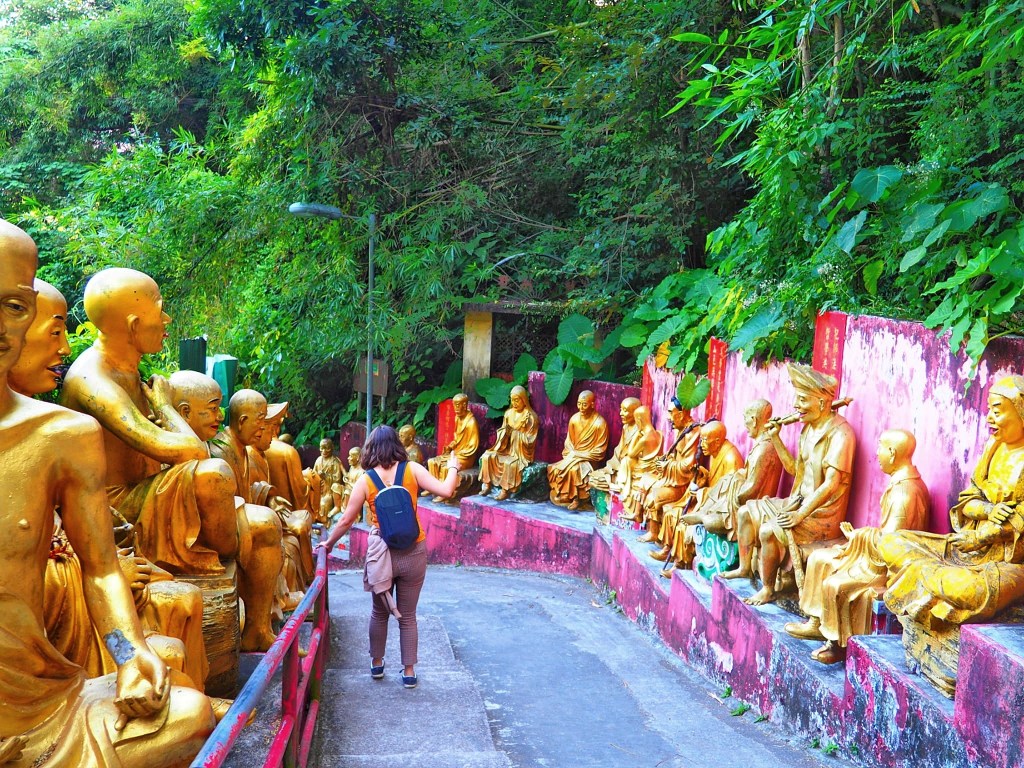
Located in Sha Tin at the outskirts of the city (New territories), the Ten Thousand Buddhas Temple was built by Yuet Kai, a monk who moved from China to Hong Kong to share the teachings of Buddhism. After his death, the care of the monastery (which currently hosts no monks) suffered from a mudslide that resulted in its temporary closure. However, it re-opened in 2000). It consists of two levels reached after climbing more than 400 stairs. The lower level contains a pagoda and the main temple hall, the walls are decorated by over 10000 figures of Buddha in different positions and the higher level, which consists of four halls with different images of Buddha.
How to get to the Ten Thousand Buddhas Monastery?
By bus: The bus will drop you off near the Sha Tin MTR Station so the instructions below apply for both.
By MTR: Exit at Sha Tin Station – East Rail Line (Light Blue) and choose exit A4. The monastery is a short walk from there. Before you see the monastery you will find a temple with escalator access, this is not part of the complex but a Buddhist cemetery. We entered by mistake and, although beautiful, we felt we disrespected the peace of the families honouring their loved ones. Just make sure to follow the signs to avoid making the same mistake (the signs may look unofficial, a piece of cardboard with an arrow, but it is genuine).
Important information: You may find fake monks asking for money on the way to the monastery, just politely decline or ignore them. Of course it’s different in some beliefs but commonly monks do not ask for money unless it’s a form of donation.
Buddhas at the entrance of the Ten Thousand Buddhas Monastery
7. Shop ’till you drop
When you visit Hong Kong you will find a great variety of places to shop; from the fanciest high-end malls to produce street markets, these were our favourite.
Ladies’ Market
One of the most famous markets in Hong Kong, this is the market where you would expect to find the best knock-off versions of known brands. The Ladies’ market sells clothes, accessories, shoes, random tech, etc. There are also lots of places to eat within and around the market.
Flower Market
This beautiful and colorful market is very popular for its incredible array of fresh flowers, definitely worth a visit even if it’s just for browsing.
Jade Market
As the name suggests, this market is specialised in selling Jade pieces and jewellery. It is a very interesting experience, the shop tellers are extremely friendly although we did find that you should try to know what you want beforehand as they will literally chase you to buy anything, also, check out how to identify real jade!
Stanley Market
This is the most popular market for souvenirs thus it is very focused for tourism, it is still a great market to walk around and browse.
Temple Street Night Market
This night market sells a bit of everything, tech, clothes, souvenirs, accessories, we did not see its full splendor as protests were happening when we visited but we did enjoy fresh cold beer sitting outside a bar by the market.
Goldfish Market
This quirky market is not just a pet market, in Chinese culture Feng Shui, fish is used in the house to bring good luck!
Shopping in Hong Kong felt to us like an otherworldly experience. We basically just wandered around entering random malls, from the high end to the quirkiest ones selling everything you can imagine. We can’t really recommend the best malls as we didn’t visit them all but we did visit some very cool ones from this guide.
8. Hike the Dragon’s Back Trail
This breathtaking trail has recently gained a lot of popularity as it has been featured in National Geographic’s World’s Best Hikes. It offers a great way to escape the hustle and bustle of the city and to get back in touch with nature.
When we went there on a Sunday there were quite a few people both Hongkongers and visitors from other countries so if you are looking for a quieter hike we may recommend going during the week. In any case, the views are unbeatable and it is a must if you visit Hong Kong.
What route should I do?
There are two routes you can take when you do the Dragon’s Back Trail. One of them will finish at the same spot where you start and you can (and should) go to Shek-O after for some food or you can finish at Big Wave Bay Beach. Either way, you can finish the trail relaxing at the beach and eating some yummy food.
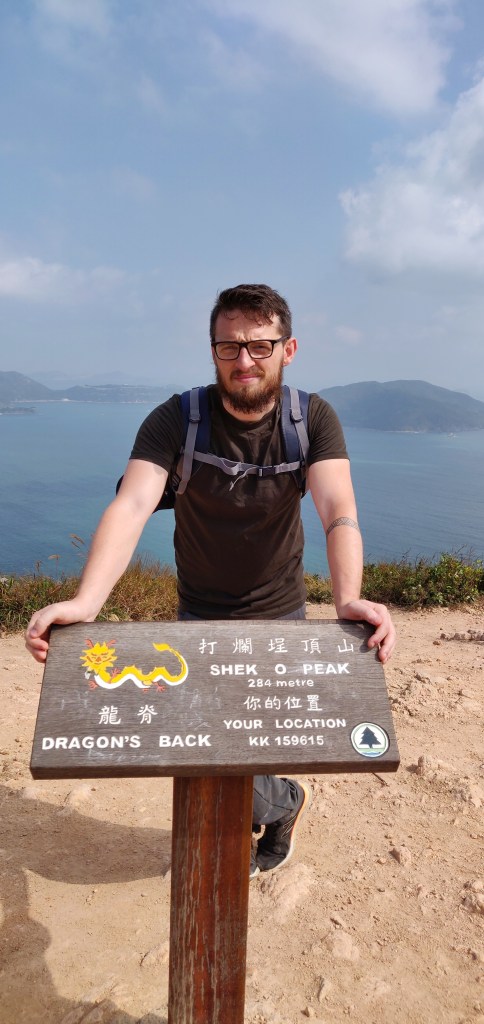
Summit of the Dragon’s Back Trail Shek-O Peak
How to get there?
To get to the start of the trail you should get the MTR from Central Station to Shau Kei Wan Station (Island Line) and then get a bus from the bus terminal (very close to the MTR station) to To Tei Wan stop (it will specify Dragon’s Back trail) we took the bus number 9.
If you have mobile data you can use Google Maps to navigate. The location of the start is here
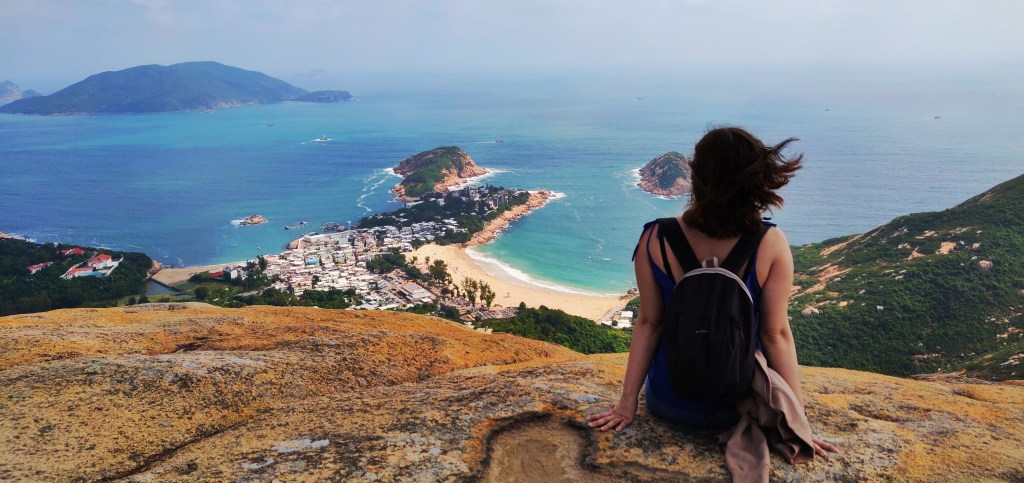
The views were just incredible all throughout the hike
What to expect
We won’t lie, it is not a smooth hike, there are lots of stairs and you will sweat (Hong Kong even in November is extremely humid) but if you have an average physical conditions you will be able to do it, we even saw kids doing the hike so it is not extremely hard. In fact the hardest part of the hike is the beginning, climbing over 500 steps. All you need is water, anti-bug spray and patience, oh, and take decent footwear we saw people wearing flip-flops. We can’t really comment on the part of the trail that continues to Big Wave Bay Beach because we did the circular route.
After the trail: Shek-O
If you decide to take the same route as us and get back to the start, take the bus number 9 again to Shek-O and enjoy some well deserved relaxation at the beach. There are also lots of restaurants and food stalls to gain back all the energies, we had some amazing Thai food washed down with fresh coconut. From Shek-O you can get a bus back to Shau Kei Wan station where you can get the MTR back into town. It will take around 2-3h approx to do the circular hike (with stops).
As mentioned above we can’t express how much we loved this hike, most people when they think of Hong Kong, the imagine is a busy city full of skyscrapers but in fact, hiking the Dragon’s back trail gives you a completely different perspective on Hong Kong, blue sky, blue sea, green mountains. Put this on your list now!
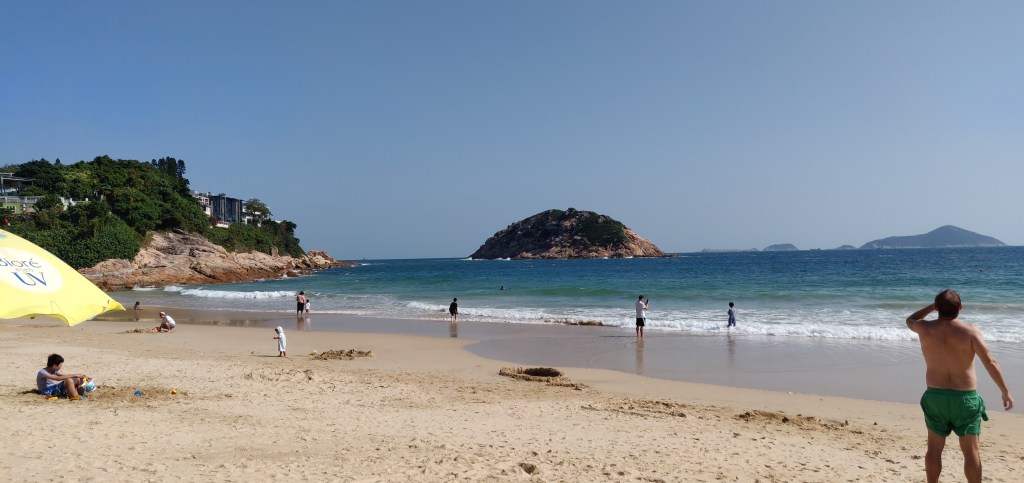
Shek-O beach (November 2019)
9. Visit the islands
Due to the volatile situation surrounding our visit to Hong Kong (protests). We didn’t manage to visit the islands this time around, but here are just some of the islands you can visit when you are in Hong Kong.
Lantau Island
Second most popular island first being Hong Kong mainland. This is the island where you can take a cable car to view the Big Buddha approximately 112 feet tall. Or most importantly Lantau Island is the home for Hong Kong Disneyland.
Lamma Island
A twenty minute ferry ride and you’ve arrived at Lamma Island, this island is mainly used for a getaway from the city, with its array of beaches and overall a relaxed hippie feel. You can easily rent a bike to explore all the hidden wonders that Lamma Island offers.
Cheung Chau Island
If you’re a seafood lover then this is the place for you. Other than the wonders of fresh seafood there are many scenic hikes you can take. If you also time your visit to the island correct you can witness the spectacular Cheung Chau bun festival. This celebration brings the entire village together, dancing the streets in costume and offering many buns to their deity.
That’s only a few islands there are of course many other islands to visit, such as Sharp Island, Tung Lung Chau, Peng Chau and the list goes on.
10. Visit the Lover’s Rock
Located nearby Bowen Road, this 9 meter granite rock is believed to give whoever touches it a happy marriage.
If you have some time to spare and you fancy some exercise (especially if you are travelling with your significant other) we recommend visiting Lover’s Rock. It can be walked from Central although if it’s hot you may want to take it easy there’s far too many steps to even count. The hike is totally worth it though, the views of the city from the top are incredible plus if you and your love touch the rock, you will become stronger together (we can vouch for that, we are still together after 4 months of traveling with each other 24/7).
What to eat in Hong Kong
Dim Sum
The best way to describe Dim Sum is to imagine them as the Chinese version of Spanish tapas, small bite-sized portions usually served in bamboo baskets. Although they are as varied as the local cuisine itself, the most internationally renowned dim sum dishes are dumplings and buns. We really enjoyed having Dim Sum at Three Virtues Vegetarian Restaurant (Nathan Road)
Wonton Noodles
These brothy, warm, egg noodles are unmissable. Although not exclusively a Hongkonese dish but Cantonese you must try them at t Mak Man Kee Noodle Shop (Central) if you don’t want to miss out.
Egg waffle
This sweet snack has taken over many cities around the world but for those who didn’t know it is a Hongkonese invention. This bubbly dessert can be flavoured and you can add as many toppings as it can physically hold. Egg waffles are available all over the city, we personally tried them in a random hole-in-the-wall shop in Central (unfortunately, cannot remember the exact location).
Roasted meat
One of the highlight foods in Hong Kong is all the deliciously roasted meat available at any restaurant, from goose to beef and even Char Siu (barbecued pork), a roastery is a must visit during your time in the city. We visited Kwan Yu Roasted Meat (near Causeway bay) and Pete loved it.
Stinky tofu
Okay, this is a weird one, neither of us particularly liked it but it is worth a try. This tofu is fermented with different ingredients that vary depending on the family recipes. You can buy it anywhere in the food markets.
If you want a special and genuine experience, try to visit one of the food courts within the malls for lunch. You will find most workers from the shops in the malls go to these courts for lunch, we loved the snippet of experience of the daily life in Hong Kong.
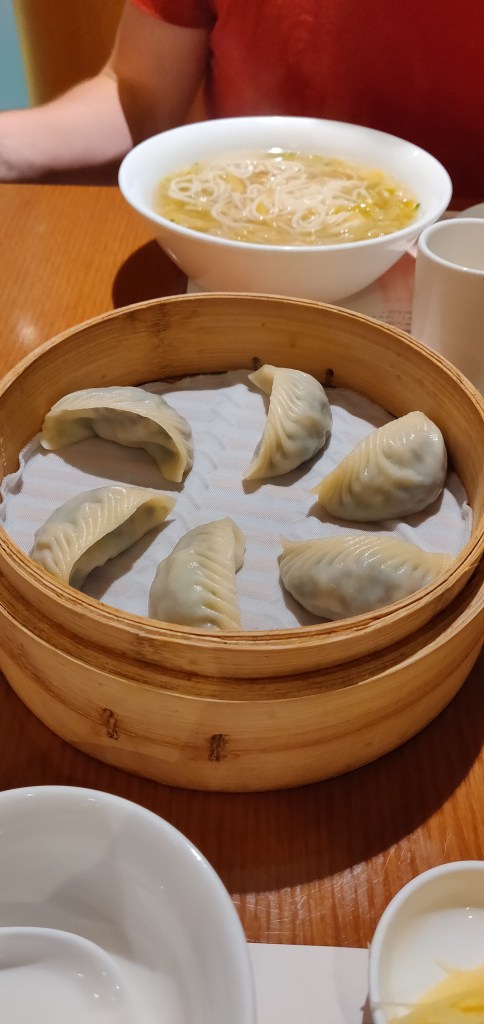
Dim Sum at the Three Virtues Restaurant
How to get in and around Hong Kong
Get in:
Air: Hong Kong has one international airport located in Lantau Island, in order to reach the city you will need to travel from Lantau. There is plenty of public transport to reach the centre and live information is available on Google Maps or HK eTransport apps. If you don’t have any mobile data, the staff at the airport can direct you to your accommodation.
Land: Hong Kong West Kowloon Railway Station has regular trains that connect to China. MTR does also offer some connections to Guangdong, you can check it here.
By sea: Hong Kong-Macau Ferry Pier connects Hong Kong with its neighbour Macau (1h trip), which is worth a trip, also Hong Kong China Ferry Terminal . The transport from both ferry piers to Central and Kowloon are very convenient by bus and MTR. You can also access other locations in China subject to availability, click here for more info.
Get around:
Moving around Hong Kong is super easy, all public transport has English as well as Cantonese signs and announcements so you will always be able to find your way. Also, most people around the touristic areas speak English so they will be able to help you.
We recommend purchasing an Octopus card to use public transport (we topped it up with 200 HKD per person for 8 days)
Tips and tricks
When to visit Hong Kong
You can visit Hong Kong at any time, there are as many outdoors activities as there are indoors but the ideal time in terms of temperature and weather would be to visit from October to December.
How expensive is Hong Kong
Well, this always depends on your budget and maintenance level of course but we exchanged 300 GBP/ 3K HKD) and it lasted for the whole week (discounting accommodation).
How to keep connected
Free WiFi is widely available in accommodation and cafes and restaurants. Also in public parks and some streets. But if you still want to keep in touch we recommend purchasing one of the prepaid data-only SIM cards available from China mobile. As we were travelling to China afterwards, we bought the Big Bay Area 30-day card and it worked perfectly in HK and Mainland (also Macau) but there are cheaper options that will only cover HK and Macau.


 travelling4tales.travel.blog